Cost of Outsourcing Social Media: A Guide for UK Businesses
Learn how much it can cost to outsource social media in the UK. Our guide explains average rates, pricing models, cost drivers, and more.



If you're a UK-based freelancer or founder dreaming of moving your business to Sweden, the Sweden self-employed visa (residence permit for self-employed people) is the main route you'll be looking at.
This guide walks you through the rules, documents, timelines and common pitfalls, so you can plan realistically.
And along the way, you'll also see how a Wise Business account can help you move your start-up capital to Sweden and manage multi-currency income with lower, more transparent fees.
| Category | Summary of Requirements & Information |
|---|---|
| 🛂 Permit Status | This is a long-term residence permit for running a business, not a short-term visa, and must generally be granted before you move to Sweden.1, 4 |
| 🏗️ Ownership & Control | You must own at least 50% of the company and demonstrate that you have the final say in its daily operations and management.2, 3 |
| 💰 Maintenance Funds | Applicants must hold personal savings of SEK 200,000, plus SEK 100,000 for a partner and SEK 50,000 per child, to cover the first two years.2, 4 |
| 📈 Commercial Viability | Your business plan must prove the venture is profitable and specifically focused on selling goods or services within the Swedish market.2 |
| 🎓 Expertise & Skills | You must provide evidence of significant industry experience, prior management responsibility, and proficiency in Swedish or English.2 |
| ⏳ Processing Time | The application process is lengthy, typically taking around 20 months, during which you must remain outside Sweden.4 |
| 💳 Application Fees | Standard fees are SEK 2,000 for the main applicant, SEK 1,500 per accompanying adult, and SEK 750 per child.4 |
| 🏡 Permanent Residency | After an initial two-year period, you can apply for permanent residency if your business is successfully supporting you.4, 5 |
Before diving into the application process, it helps to get a clear overview of what Sweden actually expects from self-employed applicants from outside the EU/EEA – which now includes UK citizens post-Brexit.
Some people talk about a Sweden business visa for self-employed or even an independent contractor visa in Sweden, but in practice, these are all informal ways of describing the same residence permit.
The core self-employed permit Sweden requirements cover ownership, maintenance funds, and proof that your business will genuinely operate in Sweden.
This route is formally a residence permit for self-employed people, not a short-term business visa, even though you'll often see it labelled online as a freelancer visa in Sweden or Sweden business visa for self-employed.
It's intended for people who want to live in Sweden and run their own business long-term, not just visit clients or attend meetings.
For non-EU/EEA citizens, you generally must have your self-employed residence permit granted before travelling to Sweden to start the business1.
To qualify, you must own at least 50% of the business and have decisive influence over management and operations (you're not a silent partner).
The EU Immigration Portal summarises this as owning at least half of the business and having ultimate responsibility2, while specialist migration advisers emphasise that, in practice, 50%+ ownership and day-to-day control is expected for this permit3.
If you're planning to team up with Swedish partners, make sure your shareholding and shareholder agreements reflect that you're the main owner and decision-maker.
Sweden requires you to show that you can support yourself (and any family members) for the first two years while the business gets off the ground. The Swedish Migration Agency currently expects at least4:
These funds must be in your personal name and clearly visible in bank statements – they are separate from any capital you plan to invest in the business itself.
💡 For UK applicants, that usually means holding or transferring a significant amount in SEK or a strong foreign currency. This is where a multi-currency solution like Wise Business can help you avoid unnecessary FX mark-ups when moving your money from GBP to SEK.
With Wise Business, you can hold over 40+ currencies in one account and convert between them at the mid-market exchange rate*, paying a small transparent fee rather than a hidden spread.
The Migration Agency will closely assess whether your business is2:
You must show contracts, letters of intent, or potential customers in Sweden, and explain how the business will generate enough income to support you and your family after the first two-year period.
To qualify as genuinely self-employed, you must also show that you2:
In practice, this can be demonstrated with CVs, reference letters, certificates, and evidence of previous freelance work or companies you've run.
The Swedish Migration Agency generally grants an initial self-employed residence permit for one year at a time during a 2-year probationary period. After this period, you can apply to extend your permit4.
If, after two years, you can show the business is operating as planned and fully supporting you financially, you may be granted a permanent residence permit at that stage, provided all conditions are met5.
In practice, many applicants are scrutinised very carefully at this point, so solid accounts, tax records and proof of real, ongoing business activity in Sweden are essential.
Officially, the Migration Agency only says that processing times "vary" depending on case complexity and completeness, but you can expect processing times of around 20 months for self-employed applications4.
That makes it crucial for UK applicants to plan finances so that they can wait that long and avoid mistakes or missing documents that could trigger extra delays.
Here's a step-by-step outline of the process if you're applying from the UK for the Sweden self-employed visa (sometimes described as an entrepreneur visa in Sweden) as a self-employed professional, freelancer or business owner.
This permit is best suited for:
If you want to run a Swedish-registered company but remain mostly based in the UK, you might not need a self-employed residence permit – there may be other corporate or remote options. But if you aim to live and work in Sweden as a self-employed person, this is usually the correct route1.
Your business plan is central to the application. It should include2:
The Migration Agency, and, in numerous instances, Swedish embassies, expect this plan to be professionally prepared and, where possible, translated into Swedish or English.
From a practical standpoint, UK self-employed applicants often incorporate a Swedish company (AB) once the permit is granted, or run the business as a sole trader (enskild näringsidkare) if appropriate.
You must show:
💡 For UK founders, these funds are often spread across GBP, EUR and SEK. A Wise Business account can be particularly useful here*, because you can:
This can also make your statements clearer: you can show the Migration Agency a dedicated account with the required funds already converted or ready to convert to SEK.
The Wise account is not a bank account but offers some similar features and your money is safeguarded.

Key documents typically include (check the latest checklist before applying)2:
As a rule, first-time self-employed residence permit applications must be submitted while you are outside Sweden4. You can usually apply online via the Swedish Migration Agency e-service (recommended), or via the Swedish embassy/consulate (for the UK, typically through the embassy in London or a VFS Global application centre).
The agency itself states that if you apply for the first time from inside Sweden without falling into one of a few limited exception categories (e.g. student who has completed studies), your application may be rejected purely on that basis4.
Current fees are4:
You'll also need to provide biometrics (photo and fingerprints) and show your passport at an embassy/consulate or designated centre before a decision can be made.
💡 A Wise Business account can be handy if you need to send application fees or related costs in SEK or EUR from the UK, as you'll see the full fee and FX rate upfront.

The Migration Agency does not guarantee a fixed processing time. For self-employed cases, around 18–20 months is common for complete applications.
During this period, you cannot move to Sweden and start your business under this permit until it's granted (unless you qualify under some other status)4.
Once your permit is granted, you can enter Sweden, collect your residence permit card, and register with the Swedish Tax Agency (Skatteverket) to obtain a personal identity number and register for F-tax as self-employed6.
You'll then formally set up your chosen business form (sole trader or company) and start trading as described in your plan. At the two-year mark, you'll apply for extension and possibly permanent residence, showing that your business now supports you fully.
At this stage, having clear accounts, including clean, multi-currency records from tools like Wise Business linked to your accounting software, can make it much easier to evidence your financial independence.
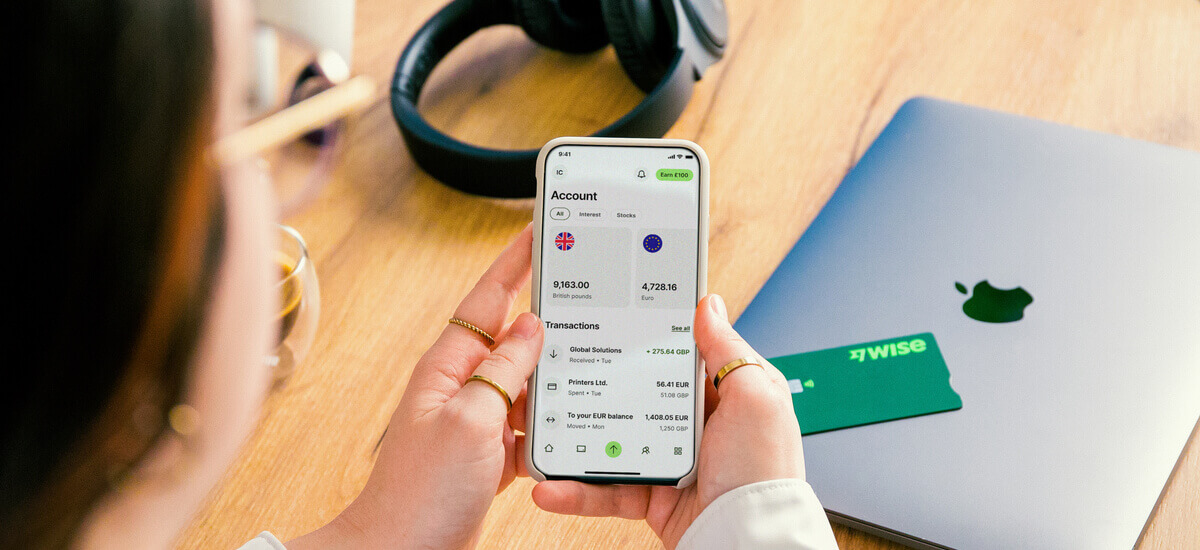
One of the biggest practical hurdles for UK applicants is moving substantial funds from GBP into SEK (and sometimes EUR) to meet Sweden's maintenance and start-up requirements. Wise Business can help you transfer and manage your money more efficiently as you prepare for your move and set up your Swedish business.
With Wise Business, you can:
Make the wise choice when selecting a business account for all your domestic and global needs.
Be Smart, Get Wise.
*Disclaimer: The UK Wise Business pricing structure is changing with effect from 26/11/2025 date. Receiving money, direct debits and getting paid features are not available with the Essential Plan which you can open for free. Pay a one-time set up fee of £50 to unlock Advanced features including account details to receive payments in 22+ currencies or 8+ currencies for non-swift payments. You’ll also get access to our invoice generating tool, payment links, QuickPay QR codes and the ability to set up direct debits all within one account. Please check our website for the latest pricing information.
You must show that you own and control a majority of the business. Official EU guidance speaks of owning at least half of the business and having ultimate responsibility for it2, while Swedish-focused advisory sources and practitioners consistently describe a requirement to own at least 50% and be directly responsible for operations and decision-making3.
In practice, UK applicants should structure their shareholdings so they hold 50%+ of voting rights and can clearly demonstrate "decisive influence" over the company.
For maintenance during the first two years, the Swedish Migration Agency expects at least2, 4:
These are minimum thresholds, so your business plan may need additional start-up capital on top of this, depending on your sector (e.g. equipment-heavy trades or retail with stock).
Because these funds must be in your personal name, many UK entrepreneurs use a multi-currency account like Wise Business to segregate and track their maintenance funds. This keeps them ring-fenced from day-to-day business spending while still benefiting from competitive GBP→SEK exchange rates.
Sweden wants to be confident that both you and your business are viable. You must therefore show2:
You must also show that your business will genuinely operate in Sweden – for example, with suppliers, customers, contracts, or letters of intent in Sweden, and that your services or goods are sold or produced there. Supporting documents often include a detailed CV, reference letters, proof of UK self-employment (HMRC documents, Companies House filings), and any language test results or certificates.
The Swedish Migration Agency states that it cannot give an exact processing time, as it depends on workload, completeness of your application, and any further checks needed. Approximately 20 months is a realistic expectation for a complete self-employed application4, and in some cases up to two years.
Because of this, UK entrepreneurs should treat 18–20 months as a planning baseline, avoid giving up UK contracts too early, and ensure their application is complete and well-documented to reduce the risk of extra delays.
The main rule is that you must apply from outside Sweden and have your permit granted before you move4. You can generally apply from your country of residence (for UK citizens, usually the UK), either online or via a Swedish embassy/consulate.
There are narrow exceptions (for example, if you already hold another type of Swedish residence permit, such as a student permit or certain work permits, and apply within its validity)4, but most UK applicants will not fall into these categories. If you apply from inside Sweden without meeting the exception criteria, your application may be rejected on procedural grounds alone.
For self-employed people, the Swedish Migration Agency typically grants a temporary residence permit for up to two years initially. Before it expires, you apply for an extension and, if eligible, a permanent residence permit at the same time4. After two years with a self-employed permit, you can be granted permanent residence if you5:
In other words, there is a potential two-year path to PR for successful self-employed entrepreneurs. However, decisions are highly case-specific, and Sweden is in the process of tightening some residence and citizenship rules more broadly, so it's wise to check the latest official guidance before you apply.
Sources:
Sources last checked on 9th March 2026
*Please see terms of use and product availability for your region or visit Wise fees and pricing for the most up to date pricing and fee information.
This publication is provided for general information purposes and does not constitute legal, tax or other professional advice from Wise Payments Limited or its subsidiaries and its affiliates, and it is not intended as a substitute for obtaining advice from a financial advisor or any other professional.
We make no representations, warranties or guarantees, whether expressed or implied, that the content in the publication is accurate, complete or up to date.

Learn how much it can cost to outsource social media in the UK. Our guide explains average rates, pricing models, cost drivers, and more.

Startups today have never faced tougher competition. With investor expectations as sky high as valuations, nearly 20% fail because they are outcompeted and...

Learn how much it costs to start a business in Japan as a UK entrepreneur. Our guide breaks down setup fees, capital needs, and ongoing expenses.

It’s never too early to start getting your business finances in order to simplify your tax admin. To help you start the new tax year on the right foot, we sat...

Learn how much outsourcing software development costs in 2026 and what drives pricing. Our guide explains rates, models, hidden costs, and more.

Learn how much it costs to start a business in Finland as a UK entrepreneur. Our guide breaks down fees, taxes, and ongoing expenses.