Best Apps to Make Money as a Freelancer in the UK
Discover the best apps to make money online as a UK sole trader in 2026. Our guide covers features, fees, and things to note about each app.


Starting a business in the UK and wondering whether to register as a sole trader or self-employed?
To help you navigate the nuances of the UK market, we’ve put together this guide to the key similarities and differences between operating as a sole trader and being self-employed.
We’ve also touched on how Wise Business can help you separate your business and personal finances while managing multi-currency income, making it a versatile business account for sole traders and self-employed individuals alike.

| Topic | Notes |
|---|---|
| Definitions 📝 | Being self-employed is an employment status (working for oneself). A Sole Trader is a specific legal business structure where the individual and the business are the same entity. |
| Business Structure 🏗️ | Every sole trader is self-employed, but not all self-employed people are sole traders (e.g., they could be in a partnership or a contractor hired through an agency). |
| Legal Liability ⚖️ | Both statuses carry unlimited liability, meaning the individual is personally responsible for all business debts, and personal assets can be used to settle them. |
| Tax Obligations 💰 | Both must register for Self-Assessment once gross income exceeds £1,000. Taxes are paid on profits via Income Tax and National Insurance. Note: This publication is provided for general information purposes and does not constitute legal, tax or other professional advice from Wise Payments Limited, its subsidiaries or affiliates. It should not be treated as advice from, or a communication with, HMRC, and it is not intended as a substitute for obtaining business advice from a tax advisor or any other professional. |
| Registration ✍️ | Registering as a sole trader is simple and inexpensive with HMRC. Deadlines for registration usually fall on 5 October following the end of the tax year. |
| Operational Control 🕹️ | Offers high flexibility and total control over decision-making, working hours, and pricing. Profits after tax belong entirely to the owner. |
| Benefits & Rights ⛱️ | No entitlement to standard employment benefits like sick pay, holiday pay, or workplace pensions. Protection is generally limited to health, safety, and discrimination. |
| Growth & Funding 📈 | Scaling can be difficult solo. It is often harder to raise capital or attract investors compared to a limited company structure. |
A sole trader is someone who owns and runs their business, keeps all the profits after tax and bears the losses1. As a sole trader, you and your business are legally the same.
It’s the simplest business structure for your UK freelance business. You won't have to bother about shareholders, company paperwork or board meetings.
This spares you admin cost, but since there are no legal differences between you and the business, you'll be fully responsible if things go wrong.
For example, Suzie, a commercial dressmaker in Camden, London, owns and runs her women’s couture business solo. She sends invoices, records income and costs in a spreadsheet, submits an annual tax return and keeps all the profits after tax.
If you own, run and make the decisions in your UK business, you're self-employed. It's an employment status that includes sole traders, partnerships, contractors and freelancers.
As a self-employed person in the UK, you only get health and safety benefits with protection from discrimination. You won't get employment benefits like sick days and paid holidays3. You can agree on some other benefits with your clients.
‘Sole trader’ is a business structure used by some self-employed people, while ‘self-employed’ is an employment status that the HMRC classifies several business arrangements, like sole-trading and freelancing, under. Some other differences between a sole trader and a self-employed person are:
A sole trader is a specific business structure under self-employment.
Think of it like this: every sole trader is self-employed, but not every self-employed person is a sole trader. Self-employed describes the broader employment status of people who work for themselves and pay tax through Self Assessment rather than PAYE.
A sole trader fully owns the business in all cases, but self-employed people could operate alone or have partners who jointly run their business.
For instance, Peter, a leading event manager in Liverpool, runs an event management company with his friend Richard. Peter handles client relations, marketing, and branding, while Richard manages operations and staff. Peter is self-employed, but he is not a sole trader because he doesn't solely own the business.
Freelancers and contractors who work independently are also self-employed, but not considered sole traders unless they register for Self Assessment.
In some cases, self-employed individuals may instead be treated as employees, such as when they are hired through an agency under a contract of employment3.
For instance, contractors may be classified as employees under employment law but remain self-employed under tax law4.
As a self-employed person, you can choose not to register for Self Assessment till you earn £1,000 gross income before tax. Signing up as a sole trader means you must pay tax through self-assessment.
Note: This publication is provided for general information purposes and does not constitute legal, tax or other professional advice from Wise Payments Limited, its subsidiaries or affiliates. It should not be treated as advice from, or a communication with, HMRC, and it is not intended as a substitute for obtaining business advice from a tax advisor or any other professional.
If you operate as a sole trader, you get to make all the decisions. You could start work at 11 am, decide how clients pay you, set your rates, and choose how much you pay yourself after tax.
Not every self-employed person gets this freedom and flexibility. A contractor with a contract of employment, or a freelancer whose service contract specifies work hours and pay, has a job disguised as a contract.
Also, whether you are a freelancer, sole trader, or consultant, you can get paid from your clients and send money to partners and contractors across the world in over 40+ for just £50 (Advanced plan) or for free (Essential plan) using Wise Business.
Here are some similarities between sole traders and self-employed individuals:
Whether you are a sole trader or self-employed, you work for yourself. You’re not on anyone’s payroll and won’t get any paid sick days or holiday bonuses.
Whether you are a sole trader or self-employed, the business is all yours (and your partners’) – the trading name, the assets, and the profits after tax.
As a sole trader or self-employed person, you are fully responsible for your business’s success or failure. While you enjoy the profits, the business’s creditors can come after your personal assets, making ‘business risk’ feel quite personal.
As a sole trader or self-employed person, once your income exceeds £1,000, HMRC expects to hear from you through Self-Assessment. They’ll calculate your tax bill based on your earnings and tax band6, plus National Insurance on your profit.
With Wise Business, you can keep complete records of global and local transactions in a local bank account in 40+ across multiple currencies. It syncs with your accounting software and is great for profit calculation and keeping tax records organised.
Neither sole traders nor self-employed people are companies. Calling yourself ‘CEO of Bart’s Food Company’ doesn't make your business ‘a company’ in the legal sense.
You’re still self-employed with great branding. You only become a company when you register as one with the Companies House.
Thinking about working for yourself? Here is why it might be the best move for you.
Registering as a sole trader is inexpensive. You only need to register for HMRC’s Self Assessment if your earnings exceed £1,000. No legal fees or unnecessary red tape.
Sole traders make all business decisions independently, without shareholders or partners giving their opinions or slowing things down. Your workflow becomes flexible enough to respond to opportunities and challenges instantly.
As a sole trader, all your profits after tax are yours. You can reinvest them in your business or keep them as personal income. Using Wise Business, you can send and receive payments from clients and partners in 40+ (or 40+ for card transactions), so you’re not losing chunks to conversion fees.
Also, unlike companies, you don’t have to declare earnings publicly. You can keep your financial transactions private.
Let’s be honest. There are some drawbacks to think about:
The flip side of enjoying all your profits is that all debts, tax penalties and business expenses fall to you. And when your business doesn’t meet up, your personal assets and savings will be used to settle the difference.
Running the business alone can make scaling difficult. Without partners or collaborators, you may be too limited to spot growth opportunities or develop new ideas.
Asking people to invest in you as a sole trader is a harder sell than finding investments as a company. Investors typically prefer limited companies since they have formal structures and clear shareholder agreements.
Sole trading can get more expensive compared to limited companies. Income Tax under Self Assessment ranges from 20% to 45%.
The basic rate of 20% applies to income between £12,571 and £50,270, while the 45% additional rate applies to income over £125,140.
By contrast, Corporation Tax for limited companies is 19% for profits up to £50,000, and 25% for profits over £250,000, with Marginal Relief for profits between £50,000 and £250,0007. This means lower tax bills at higher profit levels.
You can manage this legally by deducting all allowable business expenses, using tax-free allowances (personal and trading allowances) and making pension contributions. Wise Business can sync with your finance software and keep accurate and up-to-date records, making it easier to calculate and file your tax returns.
Some clients perceive sole traders as less credible because you're only registered with HMRC, not the Companies House as a limited company.
You can counter this by getting a business license or joining a professional or trade body.
Being self-employed in the UK has perks similar to being a sole trader, but you still get to enjoy certain peculiar benefits.
You can choose which projects to take on, set your working hours, determine pay periods, and guide the direction of your business. This lets you manage your workload and create time for other ventures. In a partnership or under a contract of service, you might not have this level of freedom.
Like sole traders, self-employed individuals fully own their business. You control the assets and profits without interference, and your earnings remain private, with no obligation to publicly disclose profits.
Self-employment allows you to earn from multiple clients simultaneously. You can set different payment arrangements with each client, including international ones. With a Wise Business Global account, you can open 8+ accounts in different countries, making it easy for clients to pay you. Opening an account costs just £50 (Advanced plan) or for free (Essential plan).
Self-employed individuals, like sole traders, have fewer administrative burdens. Your main responsibilities are choosing a business name, registering for Self Assessment, filing tax returns, and VAT registration if necessary.
Owning your business means keeping profits after taxes. Unlike limited companies, there are no shareholders to pay. Using Wise Business for business transactions only, you can separate personal and business finances with accounts in 8+ currencies, keeping your profits intact.
Some disadvantages of being self-employed are:
You're responsible for all your business debts. This puts your personal assets, such as savings or your home, at risk. So you'd need business insurance to lower risks.
Self-employed individuals are not entitled to employee benefits like sick pay, maternity or paternity leave, statutory leave, unfair dismissal protection, or workplace pensions. You must handle client disputes by yourself and ensure contracts provide the rights and protections you need.
Your income depends on securing and retaining clients. When you don't have clients, you'll be faced with a cash crunch.
Being solely in charge can limit business growth. Raising capital alone can be challenging, particularly from external investors.
Managing every part of your business can be stressful. Without employees, you handle all responsibilities yourself. Lack of formal succession planning can also threaten the business if the owner retires or passes away.
Choosing between being a sole trader and self-employed depends on factors such as your industry, income level, and personal business experience.
Either option allows you to operate legally and pay tax, and both provide protections for your business activities.
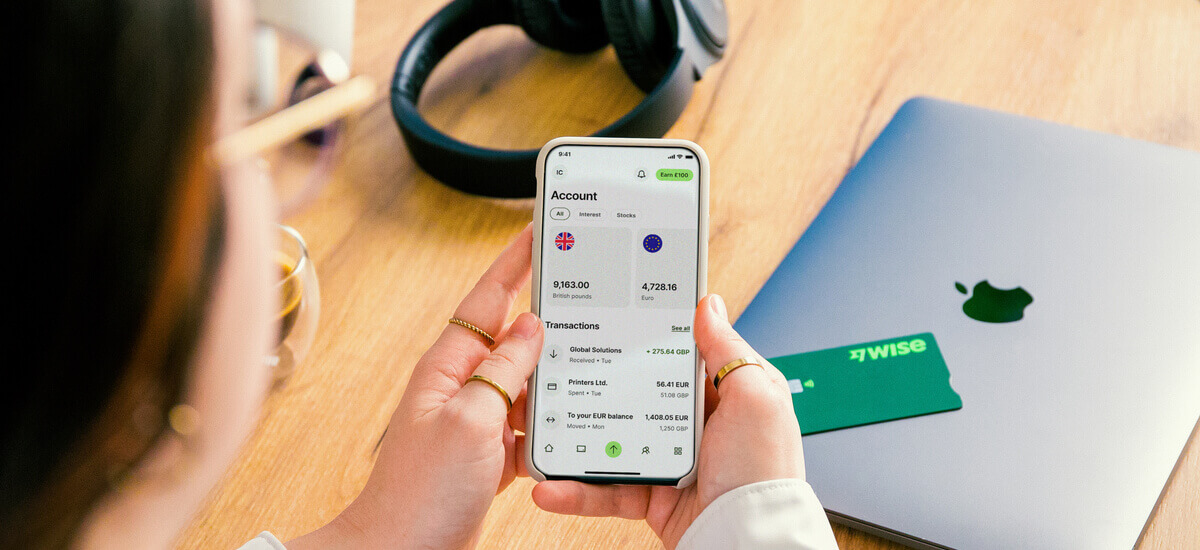
Managing your solo venture is hard enough without your bank acting like an overpaid middleman - which is why Wise Business is the perfect partner for the modern UK sole trader or self-employed solopreneur.
With a Wise Business Advanced plan*, you can ditch the steep fees and receive payments with 8+ local account details.
What’s more, you can hold 40+ currencies and send money to 140+ countries, while creating professional invoices to keep your hard-earned cash coming in.
Ready to leave behind wrestling with manual bookkeeping? Wise Business syncs with several popular accounting software so you can focus on building your business empire instead of chasing receipts.
Be Smart, Get Wise.
*Disclaimer: The UK Wise Business pricing structure is changing with effect from 26/11/2025 date. Receiving money, direct debits and getting paid features are not available with the Essential Plan which you can open for free. Pay a one-time set up fee of £50 to unlock Advanced features including account details to receive payments in 22+ currencies or 8+ currencies for non-swift payments. You’ll also get access to our invoice generating tool, payment links, QR codes and the ability to set up direct debits all within one account. Please check our website for the latest pricing information.

Not spending a fortune on international payments means we can spend more money on marketing, recruiting participants, and getting the word out there about our business.
As a self-employed individual, you can also operate as a partnership. If you want to become a company, choose between registering as a limited company or a limited liability partnership (LLP).
There is no separate tax for self-employed individuals. As a self-employed person, once your income exceeds £1,000, you should register for Self Assessment as a sole trader and pay income tax and National Insurance contributions on your profits. They are both calculated at personal tax rates.
You must register as self-employed with HMRC by 5 October after the end of the tax year in which you started your business. From April 2026, those with a qualifying income (gross turnover) over £50,000 must use Making Tax Digital for Income Tax.
You pay yourself by taking money from your business profits. You can also claim allowable business expenses, such as office costs, rent, travel and equipment, to reduce your taxable profit.
This publication is provided for general information purposes and does not constitute legal, tax or other professional advice from Wise Payments Limited, its subsidiaries or affiliates. It should not be treated as advice from, or a communication with, HMRC, and it is not intended as a substitute for obtaining business advice from a tax advisor or any other professional. **Sources:**Sources last checked on 19th December 2025
*Please see terms of use and product availability for your region or visit Wise fees and pricing for the most up to date pricing and fee information.
This publication is provided for general information purposes and does not constitute legal, tax or other professional advice from Wise Payments Limited or its subsidiaries and its affiliates, and it is not intended as a substitute for obtaining advice from a financial advisor or any other professional.
We make no representations, warranties or guarantees, whether expressed or implied, that the content in the publication is accurate, complete or up to date.

Discover the best apps to make money online as a UK sole trader in 2026. Our guide covers features, fees, and things to note about each app.

Find out how to get the most out of a Wise Business account as a freelancer in the UK. Our guide covers all features with use cases for freelancers.

Learn the differences and potential implications of using a lifetime ISA vs a self-invested personal pension to save for retirement as a freelancer in the UK.

Find out how much it can cost UK businesses to outsource customer service. Our guide breaks down pricing and key things to consider.

Learn how freelance taxes work in Italy in 2026. Our guide explains regimes, VAT, deadlines, and more.

Learn how freelance and self-employed tax works in Germany in 2026. Our guide explains registration, income tax, VAT, and key deadlines.