Austria corporate tax - guide for international expansion
Learn about the corporate tax system in Austria, its current rates, how to pay your dues and stay compliant, and best practices.



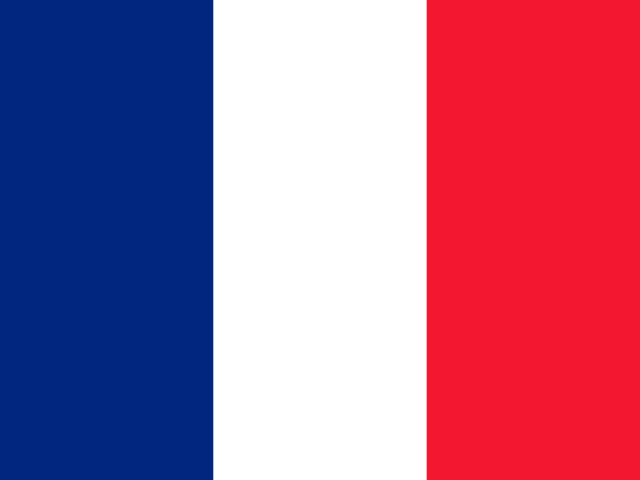
France, as one of the world’s largest economies and the most visited countries on the planet, is a popular destination for expats looking to settle. Around 8,400 Brits moved there in 2024,¹ and around 148,000 UK expats live in France in total.²
As a vibrant, modern country with a developed economy, many expats choose France as the place to launch their own business. If you're considering following this route, then you’ll need to know a bit about the processes and legalities of starting a business there.
In this guide, we’ll cover everything you need to know about starting a business in France. This includes types of corporate structure, how to register a business and your legal obligations as a business owner.
And while you start the process of expanding overseas, make sure to check out Wise Business - a powerful multi-currency account, which could help you manage company finances in France, Europe, the UK and worldwide.
The most important initial decision you'll need to make is which type of corporate structure will suit your needs in France. This matters because different business types are treated differently in law and by the tax authorities.
There are many different types of corporate entities used in France - here are some of the most common:
Choosing a company structure and setting up your business legally can be complex, especially for more sophisticated business structures. Taking legal advice and getting the support of an accountant early on is advisable, and in the case of some business structures, absolutely necessary.
If you’re not fluent in French, you may also need multi-lingual support - to translate documents, help you fill out forms, understand your obligations and generally avoid missteps and mistakes.
The amount you need to invest varies by business type - sole proprietors don’t need to invest any money to register their activities.
The amount you need to invest varies by business type - sole proprietors don’t need to invest any money to register their activities.
If you're registering a company, one of the first things to do is to check that the name you've chosen isn't already taken. The best way to do it is here at the Sirene database.
Yes, a UK national can start a business in France. However, you’ll need to have a residence permit, as well as a French social security number and a local address in France.³
For some fields of work, a particular qualification or diploma may be required (and it’ll need to be one recognised by French authorities).³
Exactly how you go about opening your business in France depends on the type of structure you select.
But to give you an idea what to expect, here’s a general overview of the process:³
The first step is to get some professional advice and then choose a legal structure for your new company that best matches its profile. It’s also a good idea to keep an eye on the future, as you may want to expand or develop the business later on.
You can also choose a company name, checking that it’s not already in use by another French business.
To register a business in France, regardless of company type, you’ll need valid ID (such as a passport), proof of address and your French social security card.. As a foreign national, you may also be asked for residency and visa documents.
For certain kinds of businesses such as EURL, SARL or SAS, you’ll also need:³
You’ll also need to complete the relevant registration form, providing all details about the company and its owner(s).
There's no one central authority for registering a business in France. Instead, you’ll need to register at one of a number of registration centres depending on which industry you’re in. These are known as Centre de Formalités des Entreprises (CFEs).
Here are your options:³
Once you’ve registered at the relevant CFE, you’ll receive a number of official documents. These include your SIRET and SIREN numbers, which identify your business both to authorities and to your clients.
You will also receive an Activite principale de l’entreprise (APE) code which identifies the main category or activity of your company.³
The main cost involved in starting a business in France is the registration fee. This ranges from €100 to €250 EUR depending on the type of business you’re registering and the CFE you’re applying to.⁴
For some business structures such as SARL or SAS, you’ll also need to make a capital deposit.
Other initial fees may include:⁴
You should also budget for insurance, fees related to setting up a business bank account in France, and professional services such as legal and accounting.
Don’t forget that you can also use multi-currency business accounts such as Wise Business to manage company finances in EUR. It could be extremely helpful to have a low-cost way to send and receive EUR payments while you get started in France, at least until your French bank account is open.
If you've registered a SARL company then the CFE will pass your details onto the necessary authorities as part of your registration. They'll inform the tax authorities, social security and labour inspection agencies, as well as the national statistics bureau and any regulatory authorities required.
You'll also need to pay tax on company income. This can be fairly complex - especially if you’re not used to the French tax system - so it’s strongly recommended to find a professional accountant to help you with this.
Once you've decided to start your business in France, you should start to build your support network there.
If you’re registering at your local CFE, they'll be able to advise you about local networking groups and support you might benefit from. You can also get information, advice, support and perhaps even funding from:
Once you’re in France and ready to get going, look for local networking events on sites such as Meetup and Eventbrite. Here you can meet new people and build your customer and business contact book.
With some planning, and a little help from your new network and friends, your business should get off to a flying start.
| 💡 You may also like our guides to doing business in France🇫🇷 |
|---|

While having a corporate bank account may be an essential for starting a company overseas, you can also use Wise Business to help grow your business in France.
Open a Wise Business account and you can manage your company’s finances in 40+ currencies all in one place, including EUR, GBP, USD and all other major currencies. You’ll be able to pay suppliers and staff in euros, as well as receiving payments in multiple currencies.
Wise payments are fast and secure (even for large amounts). Best of all, you’ll only pay low, transparent fees and always get the mid-market exchange rate.
With Wise Business, you’ll also benefit from the following features:
It’s quick and easy to open a Wise Business account in France, with a fully digital application, verification and on-boarding process. Check out the requirements here.
Wise works almost everywhere, and you can also open an account in other European countries such as Germany, Portugal, Ireland, Spain, Switzerland, Hungary and Poland.
Sources used in this article:
Sources last checked on date: 26-Aug-2025
Disclaimer: The UK Wise Business pricing structure is changing with effect from 26/11/2025 date. Receiving money, direct debits and getting paid features are not available with the Essential Plan which you can open for free. Pay a one-time set up fee of £50 to unlock Advanced features including account details to receive payments in 22+ currencies or 8+ currencies for non-swift payments. You’ll also get access to our invoice generating tool, payment links, QuickPay QR codes and the ability to set up direct debits all within one account. Please check our website for the latest pricing information.
*Please see terms of use and product availability for your region or visit Wise fees and pricing for the most up to date pricing and fee information.
This publication is provided for general information purposes and does not constitute legal, tax or other professional advice from Wise Payments Limited or its subsidiaries and its affiliates, and it is not intended as a substitute for obtaining advice from a financial advisor or any other professional.
We make no representations, warranties or guarantees, whether expressed or implied, that the content in the publication is accurate, complete or up to date.

Learn about the corporate tax system in Austria, its current rates, how to pay your dues and stay compliant, and best practices.

Learn about the corporate tax system in Botswana, its current rates, how to pay your dues and stay compliant, and best practices.

Learn about the corporate tax system in Chile, its current rates, how to pay your dues and stay compliant, and best practices.

Learn about the corporate tax system in Montenegro, its current rates, how to pay your dues and stay compliant, and best practices.

Learn about the corporate tax system in Monaco, its current rates, how to pay your dues and stay compliant, and best practices

Learn about the corporate tax system in Costa Rica, its current rates, how to pay your dues and stay compliant, and best practices.