Best Ways to Use Wise Business as a Freelancer in the UK
Find out how to get the most out of a Wise Business account as a freelancer in the UK. Our guide covers all features with use cases for freelancers.


You probably know that making money from a blog or website can be a very lucrative proposition. Note that Google Adsense is perhaps one of the best choices for bloggers who would like to monetize their websites and blogs.
Adsense is a valuable advertising program, and it allows users to run adverts on their site, blog, or even YouTube videos and easily get paid when a visitor clicks on them. This makes it an ideal platform for an Amazon Influencer, for example.
Regardless of the fact that affiliate marketing might pay more than Google Adsense, keep in mind that Adsense ads offer you the peace of mind and stability that come with recurring income, which is great. And this is why for new sites or blogs, Google AdSense is one of the quickest ways to generate income.
Reading this article you will find information about how much you can earn using Adsense, as well as how to get paid into your account, and some tips on how to manage your finances with the help of Wise Business account.

| 📝 Table of contents: |
|---|
You can earn $100, $200, or even $1,000 a day using Google Adsense from a home office. Did you know that many website owners and bloggers are doing it? Perhaps the key things you need are planning, determination, work, and passion for both your topic and niche.
Note that Google charges advertisers on the basis of ad clicks. As a publisher, you will get 68 percent of the click amount (and 51 percent when it comes to Google AdSense for search). The commission you will receive depends mainly on the competition as well as CPC in a niche. In most cases, the commission per click will range between $0.20 and $15. Also, a majority of niches fetch less than $3 a click to publishers.¹ However, remember that some niches can be more profitable.
| 💰 The amount that you earn will depend on many factors, and some of them are as follows |
|---|
The content of your webpage drives your earnings more than any other variable. For example, pages that are regarding specific topics and are also high in demand by many advertisers (and hence, there is plenty of "ad inventory") will likely earn more money compared to generalized news pages or webpages that are "multi-topic."
So, the crux is this: for the highest Adsense revenue, you should have shorter pages which are laser-focused on specific topics.
There is no doubt that ad placement is critical in Google Adsense. If visitors do not click on your adverts, regardless of how many times they are displayed, you will earn nothing.
The location of ads is really important and depends on your website layout and the traffic. However, a great starting point when it comes to the best places to locate adverts is going to the Google Heat Map page. You will find it on the Google Adsense help section.²
Note that Google pays users through check, Eletronic Funds Transfer (EFT) or bank transfer each month if their earnings either reach or are higher than $100. And if you do not earn $100 in a month, then your earnings will roll over and will be added to the subsequent month. Every time that you reach the threshold of $100, Google will issue the payment during the next payment period.³
The first step involves providing your tax information. Google may have to collect your tax-related information depending on your location. Then you will have to verify your personal information, such as Personal Identification Numbers (PINs). As they are sent to your mailing address, you should also confirm the accuracy of both your payment address as well as the payee name.
The next step involves verifying your identity. Google may have to verify your identity with the help of information, such as your name, and address, etc. depending on your location.⁴ Now, you will have to verify your address.
After verifying your address, you will have to select your form or kind of payment. You may select your preferred form of payment when your monthly earnings reach the threshold for the payment method selection. You may use various types of payment, depending on the payment address. Some of them are EFT (Electronic Funds Transfer) and wire transfer, etc.
Now all you have to do is meet your payment threshold. Note that a 21-day payment process period will begin if your current balance hits the payment threshold before the month ends.⁵ After the end of the processing period, Google will make you a payment.
Google Adsense will calculate your income for a full month period. Once the month ends, Adsense will take a couple of weeks in order to review the earnings and then identify any false impressions as well as clicks before finalizing your payment.
They complete this review normally by the 20th of the next month. And Adsense will send the payments in the final week of the following month. If you have completed all the steps to get the payment, Google will issue a payment from the 21st to the 26th of the relevant month. You will also see a line item during this time. It will appear on the "Transactions" page and indicate that the payment is now in progress.⁶
However, for EFT, you will have to wait four to ten days in order to receive the money in your bank after the payment process has started. On the other hand, a wire transfer may take up to fifteen days to reach your bank account.
As a publisher, you can make money simply by writing quality content and using Adsense for monetization. When it comes to long-term success on Google Adsense, you will need to write quality content that will help draw in more people to your website or blog.
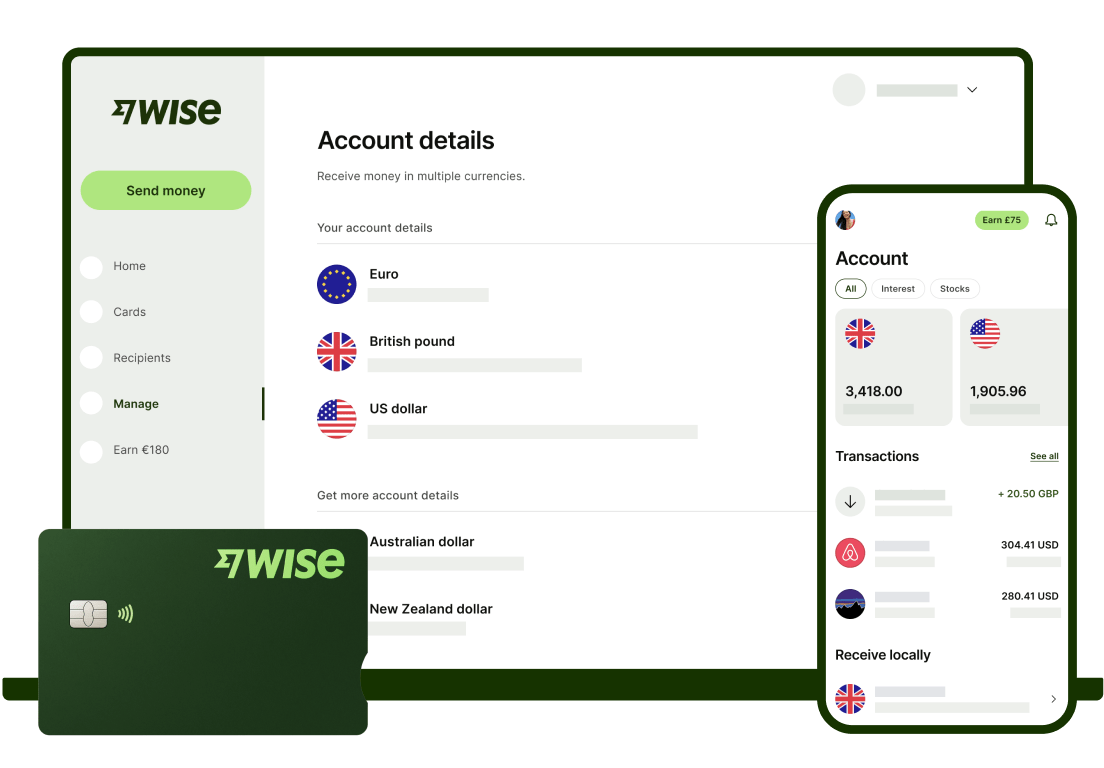
Unfortunately, you cannot use your Wise Account to get paid by Adsense. However, after withdrawing your well deserved earnings, if you need to make payments for international providers, you can benefit from a Wise Business multi-currency account.
Creating content online, as a side hustle or full time job, takes lots of time and effort. And even though the initial costs are low, if you take the business to another level it is quite possible that you need to pay for some online services like web hosting, or even for other professional ones, such as a web designer.
With Wise Business you’ll always get the real, mid-market exchange rate with low, transparent fees. You can then use your multi-currency account to pay for international invoices, online services and freelance professionals to help grow your digital business.
| 💡 Here’s an example of this in action: |
|---|
| Let's say you need to hire a freelancer to help you scale your business, creating more articles for your blog or screenplays for your Youtube videos. You find an amazing freelancer who resides in the US, and so, you need to pay this person in US dollar (USD). With the Wise business account you can easily hold money on your local currency, and when you need to pay your freelancer's invoice, you can send an international transfer, paying the real conversion rate, without any hidden fees. Wise Business isn’t only a handy tool for international transfers. If there’s a chance you’ll be receiving payments in any other currencies, your multi-currency account offers one of the cheapest ways to manage, convert, send and spend your money. |
Get started with Wise Business
*Disclaimer: The UK Wise Business pricing structure is changing with effect from 26/11/2025 date. Receiving money, direct debits and getting paid features are not available with the Essential Plan which you can open for free. Pay a one-time set up fee of £50 to unlock Advanced features including account details to receive payments in 22+ currencies or 8+ currencies for non-swift payments. You’ll also get access to our invoice generating tool, payment links, QuickPay QR codes and the ability to set up direct debits all within one account. Please check our website for the latest pricing information.
Sources used in this article:
Sources last checked March 03, 2023
*Please see terms of use and product availability for your region or visit Wise fees and pricing for the most up to date pricing and fee information.
This publication is provided for general information purposes and does not constitute legal, tax or other professional advice from Wise Payments Limited or its subsidiaries and its affiliates, and it is not intended as a substitute for obtaining advice from a financial advisor or any other professional.
We make no representations, warranties or guarantees, whether expressed or implied, that the content in the publication is accurate, complete or up to date.

Find out how to get the most out of a Wise Business account as a freelancer in the UK. Our guide covers all features with use cases for freelancers.

Learn how much outsourcing accounting costs for UK businesses. Our guide explains pricing, services, and factors affecting fees.

Learn how much outsourcing graphic design costs in the UK. Our guide explains typical rates, cost factors, and budgeting tips.

Discover how small businesses in the UK are using AI to boost growth and revenue. Our guide details practical use cases for all types of small businesses.

Learn how much it can cost to outsource social media in the UK. Our guide explains average rates, pricing models, cost drivers, and more.

Startups today have never faced tougher competition. With investor expectations as sky high as valuations, nearly 20% fail because they are outcompeted and...