Due diligence in Portugal
Read more about property due diligence in Portugal, including essential documents, title checks, surveys, costs and common risks for buyers.



If you are a UK national thinking about building a career in the EU, the EU Blue Card is one of the main routes to live and work there long-term.
It is designed for highly skilled professionals from outside the EU who have a strong job offer and meet salary and qualification requirements. Because each EU country implements the rules slightly differently, the exact conditions, salary thresholds, and processes vary.
This article will cover how the EU Blue Card works, who can apply, and what to expect from the application.
And if you’re looking to relocate to Europe, learn how the Wise account can save you money on your sending abroad.
This content is produced in partnership with Louis Bouyala, founder at EasyStart Relocation for informational purposes only and does not constitute tax or legal advice. Personal circumstances vary; always consult a qualified professional, such as the team at EasyStart Relocation, before making financial decisions.
The EU Blue Card is a combined work and residence permit for highly qualified non-EU/EEA citizens who want to live and work in an EU Member State.
It gives the holder the right to reside in a particular EU country, work in a highly skilled job there, and, over time, access a more stable residence status and certain mobility rights within the EU1.
In broad terms, you may be eligible if you are a non-EU/EEA citizen with higher professional qualifications (or equivalent experience), a suitable job offer in an EU country, and a salary that meets or exceeds the national EU Blue Card threshold.
Member States can set additional conditions, but those core elements (skills, contract, and salary) are common1.
Since Brexit, UK nationals are "third-country nationals" from the EU's perspective, which means they can no longer use EU free-movement rules and must use schemes such as the EU Blue Card if they want to work in the EU long term. In principle, British citizens are treated similarly to other non-EU nationals1:
Recent changes to EU law and national rules have made it easier for some IT and ICT professionals to qualify without a traditional university degree.
Directive (EU) 2021/1883 requires Member States to recognise certain professional experience as an alternative to higher-education qualifications in information and communication technology roles2.
Several countries, like Germany, the Netherlands, and France, now allow IT specialists to apply for the EU Blue Card. As long as they can prove at least three years of relevant professional experience over the previous seven years, even without a degree, and provided they still meet the salary threshold and other conditions.
Although details vary by country, most EU Blue Card applications follow a similar structure. You must show that you meet the basic conditions, hold a suitable employment contract for long enough, and can prove your qualifications or professional experience1.
Typical baseline EU Blue Card requirements include1:
Some countries also require proof of health insurance, a clean criminal record, or accommodation arrangements as part of the visa or residence-permit process. Requirements must be checked on the relevant national portal.
Under the updated EU rules, the minimum duration for an EU Blue Card job offer or contract is six months, although some countries choose to require 12 months or longer1.
The role must be genuinely highly qualified and relevant to your education or professional experience: for example, an engineering graduate working as an engineer, not in a low-skilled, unrelated job.
National authorities may also check whether the job is full-time, whether the employer is compliant with labour law and social security rules, and whether local labour-market tests apply.
Most applicants will need to prove higher professional qualifications with a recognised degree, such as a bachelor's or master's, or in some cases a PhD1. This usually involves providing diplomas, transcripts, and sometimes an official recognition or comparability assessment if the degree was obtained in a non-EU country such as the UK.
Where national law recognises professional experience as an alternative, you will need detailed evidence such as employer reference letters, contracts and job descriptions. In every case, the documents generally must be translated into the host country's language or English by a certified translator if they were originally issued in another language.3
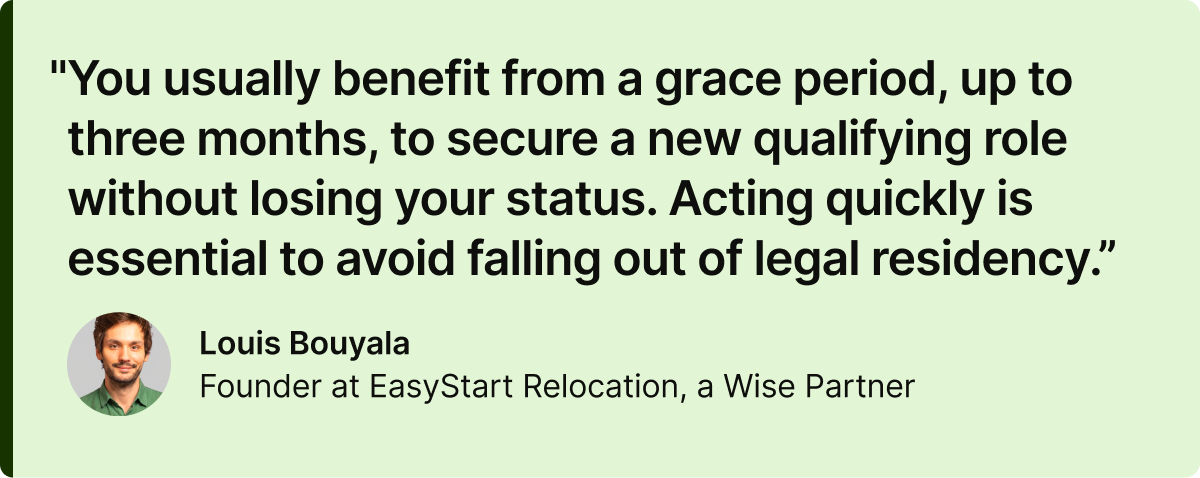
There is a small window to find another job if this happens and according to Louis Bouyala, founder at EasyStart Relocation, French visa and EU Blue Card specialists, this is up to 3 months:
“You usually benefit from a grace period, up to three months, to secure a new qualifying role without losing your status. Acting quickly is essential to avoid falling out of legal residency.”
Salary thresholds are a central part of EU Blue Card eligibility and are set individually by each participating Member State.
The new rules require countries to fix their minimum salary between 100% and 160% of the average national gross annual salary, instead of the previous higher ceilings, to make the scheme more accessible4.
There is no single EU-wide minimum salary, as each participating country sets its own threshold within the range allowed by EU law.
The general principle is that your gross annual salary in the job contract or binding offer must be at least equal to the national Blue Card threshold, which is normally a multiple of the country's average salary.
EU law allows Member States to fix the threshold between 1.0 and 1.6 times the average gross annual salary in that country, with the possibility of slightly lower thresholds, provided it does not fall below the average salary4.
Here are some examples of current salary thresholds for general (non-shortage) EU Blue Card roles as of 2025–2026:
In many Member States, reduced salary thresholds apply for certain categories of applicants.
Under Directive (EU) 2021/1883, countries may use lower thresholds (down to 80% of their standard Blue Card threshold) for highly qualified workers in shortage occupations and for some recent graduates, as long as the reduced figure is not less than the average national salary3.
Germany, for example, sets a lower threshold for shortage-occupation roles, including many engineering, medical and IT positions. For 2026, the reduced threshold is €45,934.20, provided the Federal Employment Agency has approved the employment2.
The EU Blue Card is applied for at the national level, so the exact procedure, responsible authority and timelines differ between countries.
In some places, you apply for a long-stay visa and Blue Card from outside the EU via the consulate, then collect the card after arrival.
In others, you may already be in the country on a different residence permit and apply to switch to a Blue Card at the local immigration office.
Despite these differences, most processes share similar document requirements and basic steps1.
Typical documents requested (which can vary by country) include1,3:
Although the details differ, here's a typical rundown on how to get the EU Blue Card in a few simple steps:
It’s important to ensure you have all relevant documents and haven’t missed anything if you want your Blue Card to be processed quickly and efficiently.
Relocation expert and founder at EasyStart Relocation, Louis Bouyala, finds that one of the main reasons for processing time delays is missing documents.
“Missing documentation or inconsistent contracts are the most common causes of delays in our cases.”

Securing an EU Blue Card requires meticulous attention to detail and administrative slips, rather than eligibility issues, are a leading cause of visa setbacks.
Given that Blue Card approvals often hinge on precise contract details and proof of education, a pre-application review by a specialist can prevent your file from being sidelined for months.
Moving abroad from the UK on an EU Blue Card can be exciting, but it also involves significant financial planning.
You may need to pay for flights, temporary accommodation, rental deposits, shipping costs and, eventually, day-to-day living expenses in euros or another EU currency before your first salary arrives.
On top of that, you might still have commitments in the UK, which means managing money in both GBP and your new currency at the same time.
A Wise account and Wise card can help you bridge this UK–EU gap more efficiently. With Wise, you can hold and convert multiple currencies at the mid-market exchange rate, send money to your new EU bank account or landlord with transparent, low fees, and spend directly in the local currency with your Wise debit card when you arrive.
This can reduce the impact of hidden FX mark-ups compared to many traditional banks, making your relocation budget go further.
When your EU salary starts coming in, you can continue using Wise to move money back to the UK, split costs with friends or family, and manage finances across borders with more control and fewer surprises.
Sources used:
1. European Commission – British citizens are eligible
2. Make it in Germany – the new Skilled Immigration Act
3. Maahanmuuttovirasto – documents generally must be translated
4. EUR-Lex – EU Blue Card entry and residence
5. Welcome to France – France’s salary thresholds
6. Jobbatical – Spain's salary thresholds
Sources last checked on date: 13 January 2026
*Please see terms of use and product availability for your region or visit Wise fees and pricing for the most up to date pricing and fee information.
This publication is provided for general information purposes and does not constitute legal, tax or other professional advice from Wise Payments Limited or its subsidiaries and its affiliates, and it is not intended as a substitute for obtaining advice from a financial advisor or any other professional.
We make no representations, warranties or guarantees, whether expressed or implied, that the content in the publication is accurate, complete or up to date.

Read more about property due diligence in Portugal, including essential documents, title checks, surveys, costs and common risks for buyers.

Read more about property due diligence in Australia, from title searches and vendor disclosures to inspections, costs and checks for foreign buyers.

Read more about how to get a NIF number in Portugal, including who needs one, required documents, application options, costs and rules for UK expats.

Learn how capital gains tax on inherited property in Australia works, including exemptions, foreign resident rules and tax when selling an inherited home.

Read more about hiring a property lawyer in Portugal, including what they do, how to check their qualifications and the legal fees you can expect.

Read more about property valuations in Australia, from mortgage and pre-sale valuations to costs, methods, timelines and finding a qualified valuer.