


Best Apps to Make Money as a Freelancer in the UK
Discover the best apps to make money online as a UK sole trader in 2026. Our guide covers features, fees, and things to note about each app.




If you’re self-employed in the UK and work in culture or sport, you may have looked into the Canada self-employed visa (the Self-employed Persons Program) as a route to permanent residence.
Although the federal Self-Employed Persons Program is currently paused,1 understanding how it operates still matters if it reopens or if you’re weighing up similar immigration pathways.
To help you prepare for a potential move or evaluate your current eligibility, we’ve put together this comprehensive guide on the requirements, costs, and selection criteria. We’ve also explored how Wise Business can help you manage your self-employment across borders.
| Topic | Key takeaways |
|---|---|
| ⏸️ Current Status | The federal programme is currently paused. Applicants should monitor for reopening or consider alternative pathways in the interim. |
| 🎨 Eligibility Focus | Exclusively for those in cultural activities or athletics who can prove they will significantly contribute to Canada’s local scene. |
| ⏳ Experience Criteria | You must demonstrate at least two years of relevant, high-level or self-employed experience within the five years prior to applying. |
| 📊 Selection Grid | Applicants must score a minimum of 35 out of 100 points across five factors: experience, education, age, language, and adaptability. |
| 📝 Application Style | This is an online process (not Express Entry) requiring specific forms like Schedule 6A to detail your professional history1. |
| 📎 Essential Evidence | Beyond forms, you’ll need robust proof of work (contracts/invoices), valid language test results, and Educational Credential Assessments (ECA). |
| 💰 Financial Costs | Total fees for a single applicant exceed 2,300 CAD, covering non-refundable processing, biometrics, and the Right of Permanent Residence fee. |
| 🩺 Health & Security | Mandatory medical exams by IRCC-approved physicians and police certificates from every country you’ve lived in for 6+ months are required. |
| 🗺️ Alternative Routes | If the federal route is closed, look into the Start-Up Visa, Quebec’s specific programme, or various Provincial Nominee Programs (PNP). |
Before you look at forms or fees, check that you meet the programme’s definition of a self-employed person.
The federal Self-Employed Persons Program is for people who have relevant experience in cultural activities or athletics and who can make a significant contribution to Canada’s cultural or athletic life.2 It isn’t a general business or freelance visa.
You must have either:
IRCC assesses whether your past work genuinely fits those categories. It’s not about calling yourself self-employed. It’s about showing that your work and track record sit clearly within cultural or athletic fields.
You need at least two years of relevant experience within the five years before you apply. That experience can be:
The experience must relate directly to cultural activities or athletics. Officers look at whether it’s real, documented and continuous.
Meeting the two-year rule is only part of it. You must also show that you intend and are able to continue working in your field in Canada.
In practice, that means showing how you will support yourself through your work once you arrive. The programme is built around contribution, not passive investment.
💡 If you’re planning financially for a future move, that may include organising settlement funds and deciding how you would transfer money from the UK to Canada.
Wise Business lets you convert GBP to CAD with transparent fees, which can help you budget more clearly if and when you need to move funds.
To qualify under the federal Self-Employed Persons Program, you must score at least 35 points out of 100 on Canada’s selection grid. The pass mark is lower than some other economic immigration routes, but you still need to meet the threshold.
Canada awards points across five factors:3
Experience carries the highest weight, with a maximum of 35 points. You must have at least two years of relevant experience to qualify. The more qualifying years you have, the more points you receive. Experience must be in cultural activities or athletics, either as a self-employed person or at a world-class level.
Immigration officers look at whether your work matches eligible National Occupational Classification (NOC) codes and whether it was continuous and genuine.
Education is worth up to 25 points. IRCC calculates points based on your highest completed qualification. Secondary school completion earns fewer points than a recognised post-secondary qualification. Degrees, diplomas and trade qualifications are all assessed against Canadian equivalency standards.
If your qualification was awarded outside Canada, you may need an Educational Credential Assessment to confirm its level.
Age is worth up to 10 points and applicants aged 21 to 49 receive the highest point. Points gradually reduce outside that range.
Language can contribute up to 24 points. You must take an approved test in English or French. For English, that usually means International English Language Testing System (IELTS) General Training or Canadian English Language Proficiency Index Program (CELPIP). Your scores are converted into Canadian Language Benchmark (CLB) levels, which determine how many points you receive.
Even moderate language ability can help you reach the 35-point threshold.
Adaptability is worth up to 6 points. Points may be awarded for factors such as previous study or work in Canada, or if your spouse or partner has certain qualifications or language ability.
While 35 points is the minimum, immigration officers also assess whether you genuinely intend and are able to become self-employed in Canada. The points test is only one part of the assessment.
💡 If you’re preparing for a possible application, it’s sensible to plan your finances early. That includes understanding how you would transfer settlement funds from the UK to Canada if the programme reopens.
Wise Business allows you to send payments in CAD at the mid-market rate, helping you see the true cost of moving money internationally.
Once you know you meet the eligibility rules and can reach 35 points, the next step is paperwork. This is where many applications slow down or get returned.
For the federal Self-Employed Persons Program, you must submit the application online, not through Express Entry1. IRCC publishes the required forms and document checklists. You must use the most recent versions available on the official IRCC website.
You’ll usually need to complete:4
Schedule 6A is specific to this programme. It asks for detailed information about your self-employment history, the nature of your work, and how you plan to continue that work in Canada.
Validate every form (where required), then sign and date it correctly. Missing signatures are one of the most common reasons applications are returned.
You need clear evidence of at least two years of qualifying experience. That can include:
The evidence should show the dates of your work, the nature of the activity and that you were self-employed or competing at the required level.
If you’re claiming points for education, include copies of your certificates and transcripts. If your qualification was obtained outside Canada, you may need an educational credential assessment (ECA) from a designated organisation.5
For language points, include your official test results from an approved provider. Make sure your test results are still valid when you apply.
You’ll also need:
Documents not in English or French must be translated by a certified translator.
IRCC provides a document checklist specific to the Self-Employed Persons Program. Follow it closely. Incomplete applications are typically returned without being processed.
💡 If you’re preparing settlement funds in advance, you can use Wise Business to keep clear records showing the source of those funds, as when moving money internationally, you may be asked to provide proof of origin.
You cannot submit a Canada self-employed visa application without first paying the required IRCC fees. You pay the fees online through the official IRCC payment portal.
Here’s what applies under the federal Self-Employed Persons Program:6
IRCC refunds the Right of Permanent Residence fee if it refuses your application, but the processing fee is non-refundable.
You’ll receive a payment receipt after paying online. That receipt must be included with your application package.
💡 If you’re paying from the UK, you may be charged foreign transaction fees that can be hidden in the exchange rate provided to you when converting GBP to CAD.
Wise Business lets you pay in Canadian dollars at the mid-market rate, so you can see the exact cost before you confirm the payment.
When the programme is open, you submit the full online application in one go1. Everything must be included at once: forms, supporting documents, photos and proof of payment.
IRCC checks for completeness first. If a required form is missing, not signed, or outdated, the application is usually returned without being processed.
Once IRCC accepts your application as complete, they will issue an acknowledgement of receipt (AOR) and assign you a file number.7 From that point, all communication comes through your online account or by formal correspondence.
Keep copies of every document you send. You may be asked later to provide updated police certificates, language test results, or proof of funds if processing takes time.
After IRCC reviews your file, you’ll receive instructions for a medical examination. This must be completed with an IRCC-approved panel physician. You cannot use your own doctor. The results are sent directly to immigration authorities.8
Police certificates from every country you’ve lived in (excluding Canada) for 6+ months are required.9 IRCC runs security screening as part of your background check. This covers criminality and inadmissibility under Canadian immigration law.
You will not receive permanent residence until you pass medical and security checks and IRCC is satisfied that you meet the programme requirements.
If you’re preparing settlement funds in advance, keep clear records showing the source of those funds. If you transfer money from the UK to Canada, retaining proof of transfer and conversion rates can make the final review stage smoother.
As mentioned earlier, the federal Self-Employed Persons Program is still paused and there’s no confirmed reopening date. If you’re building a long-term plan to move to Canada, it’s sensible to look at other routes rather than wait.
Here are the main alternatives UK applicants usually consider.
The Canada Startup Visa is a federal route to permanent residence for entrepreneurs building an innovative business in Canada.
To qualify, you need:
Unlike the immigration self employed Canada route, this is about launching and scaling a business, not working independently in a cultural or athletic field.
Most provinces operate business immigration streams under their Provincial Nominee Program.
These typically require:
Criteria vary by province. Investment levels and net worth thresholds differ between Ontario, British Columbia, Alberta and others. These streams are broader than the self-employed PR Canada category and are not limited to cultural or athletic occupations.
Quebec manages its own immigration system. The Quebec self-employed stream has separate criteria from the federal programme and includes:
You must first secure a Quebec Selection Certificate before applying for permanent residence at the federal level.
Some UK applicants qualify through Express Entry instead, depending on their occupation and work history.
Express Entry manages applications under the Federal Skilled Worker Program, Canadian Experience Class and Federal Skilled Trades Program. It is points-based and competitive, not tailored specifically to self-employed cultural professionals, but it can be an option.
Each route comes with financial requirements. Some require settlement funds. Others require proof of investment capital or net worth.
💡 If you’re preparing funds in the UK, you may need to provide clear documentation of the source of the funds and how they're being transferred.
With Wise Business, you can hold over 40 currencies in one account and send payments to Canada with no hidden fees. That can make it easier to manage funds across GBP and CAD while keeping clean transaction records for your application.
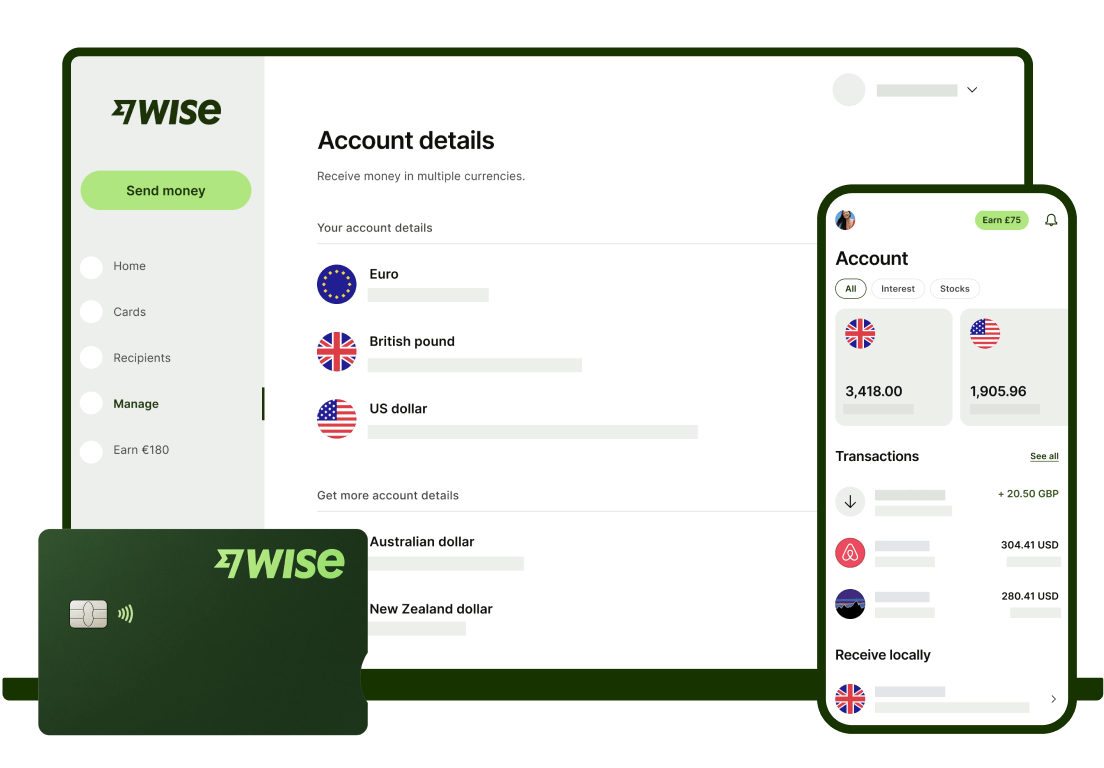
If you’re preparing settlement funds or planning how to move money from the UK to Canada, having a clear view of fees and exchange rates makes a real difference. That’s where Wise Business comes in - it helps you send and manage international payments in CAD without hidden exchange rate mark-ups.
There isn’t a fixed number published for this programme. The federal rules don’t set a minimum net worth. You just have to show you have enough money to support yourself and any family members after you land in Canada.
How much is “enough” depends on your family size and your situation. The funds must be available and transferable. Officers will look at whether the money is genuinely yours and accessible.
The federal programme only covers people in cultural activities or athletics. It doesn’t set a minimum net worth requirement.
Quebec runs its own self-employed worker stream. It isn’t limited to cultural or athletic occupations, and it does include a minimum net worth requirement.
You apply to Quebec first. If selected, you then apply federally for permanent residence. They’re separate systems with different rules.
A lot of problems come down to missing paperwork. For example, you didn’t sign forms or you submitted the wrong version of a form.
Refusals also happen when the experience doesn’t clearly fit the cultural or athletic categories, or when the evidence is thin.
If you say you were self-employed, you need to show it properly with documents. Follow the IRCC checklist exactly and don’t assume something is obvious.
The programme refers to National Occupational Classification categories tied to cultural activities and athletics. That includes roles like musicians, actors, visual artists, writers, film and broadcasting technicians, professional athletes and coaches.
The key thing is that your duties match the NOC description. The title alone isn’t enough.
There’s no single document that ticks this box. Officers look at your track record and your plans for Canada. Contracts, invoices, tax returns, awards, press coverage, competition records and letters from clients or organisations can all help.
You also need to show a realistic plan. Not just that you want to move, but also how you will continue working in your field once you’re there.
Sources:
Sources last checked on 5th March 2025
*Please see terms of use and product availability for your region or visit Wise fees and pricing for the most up to date pricing and fee information.
This publication is provided for general information purposes and does not constitute legal, tax or other professional advice from Wise Payments Limited or its subsidiaries and its affiliates, and it is not intended as a substitute for obtaining advice from a financial advisor or any other professional.
We make no representations, warranties or guarantees, whether expressed or implied, that the content in the publication is accurate, complete or up to date.

Discover the best apps to make money online as a UK sole trader in 2026. Our guide covers features, fees, and things to note about each app.

Find out how to get the most out of a Wise Business account as a freelancer in the UK. Our guide covers all features with use cases for freelancers.

Learn the differences and potential implications of using a lifetime ISA vs a self-invested personal pension to save for retirement as a freelancer in the UK.

Find out how much it can cost UK businesses to outsource customer service. Our guide breaks down pricing and key things to consider.

Learn how freelance taxes work in Italy in 2026. Our guide explains regimes, VAT, deadlines, and more.

Learn how freelance and self-employed tax works in Germany in 2026. Our guide explains registration, income tax, VAT, and key deadlines.