Revolut business review: Plans, fees, and Australian alternatives
Read here for a review on Revolut Business in Australia. Compare multi-currency features, subscription plans, out-of-hours transfer fees, and alternatives.



Launching your first business? You’re probably wondering what a merchant account is and whether you even need one. If accepting direct card payments from customers is in your business plan, chances are you will need a merchant account – or an alternative service.
In this post, we’re covering everything an Aussie SMB should know about the merchant account, including its benefits, processes, requirements, and fees. We’ll also introduce Wise Business, a cost-effective alternative for Australians trading overseas.
| Table of Contents |
|---|


A merchant account is a special type of business account exclusively used to accept card payments. Modern merchant accounts work with credit and debit cards from all the major card schemes – Visa, Mastercard, eftpos, etc. – as well as mobile wallets like Google Pay and Apple Pay.
After receiving a card payment, the merchant account temporarily holds onto the funds before transferring them to the linked business account. But the merchant account doesn’t actually process the payment; the payment gateway handles that step.
Aussies aren’t real keen on cash. According to the Reserve Bank of Australia, only 15% of payments were made in cash in 2025,1 with many customers favouring Tap-and-Go card payments. As a merchant account is required to accept card payments, it’s a non-negotiable for many businesses.
Exceptions exist. Online marketplaces, such as eBay, Amazon, Etsy, and Upwork, handle card payments and transfer funds to your business account, minus any fees. That means you can get paid by card on these platforms without a merchant account.
But if you’re billing cards directly from customers, you will need a merchant account or an alternative, such as a Payment Service Provider (PSP).
The merchant account receives and holds card payments before transferring them to your business account. But it’s the payment gateway that processes them.
For online purchases, the payment gateway is usually a secure pop-up window where the customer enters card details to finalise a transaction. In physical, brick-and-mortar stores, the best payment gateways are built into the POS machine.
The merchant accepts revenue. The business account helps you manage it.
The business account is where you store and manage finances. From this pool of liquid capital, you can pay bills, deduct payroll for employee salaries, track expenses, and purchase stock, among other day-to-day business transactions.
In Australia, partnerships, companies, and trusts must open a business account. Sole traders aren’t legally obligated, but the ATO recommends getting one anyway.2
The merchant account is optional. But you will need one, or an alternative, to accept direct card payments.
| Feature | Merchant account | Business account |
|---|---|---|
| Purpose | Accepting and temporarily holding card payments before transferring them to the business account | Storing and managing business funds |
| Typical use cases | EFTPOS, online payments, mobile payments, payment gateways | Paying suppliers, payroll, bills, tax, and other business expenses |
| Legal requirement | Not legally required | Partnerships, companies, and trusts must open one; recommended for sole traders2 |
| Access to funds | Funds held temporarily until transferred to business account (typically 1-3 business days) | Funds accessible at any time |
Here’s how the merchant account fits into the payment process.
So while the merchant account holds card payments, it doesn’t actually process them.
All the big four banks – CBA, NAB, ANZ, and Westpac – offer merchant accounts, EFTPOS terminals, online payment gateways, and other payment solutions. Many of the smaller Australian banks also offer merchant accounts and payment services, including Bendigo Bank, Bankwest, Bank of Queensland, Macquarie Bank, and Suncorp Bank.
Businesses can also select from all-in-one PSPs, such as Stripe, Square, and PayPal. Australians trading overseas could save on foreign exchange fees through a PSP specialising in cross-currency transactions, such as Wise Business.
Processes vary by bank and PSP. Nonetheless, here’s a rough breakdown of how to set up a merchant account.
All-in-one PSPs tend to be faster, easier, and cheaper to set up, making them popular with start-ups, sole traders, and low-volume SMBs. Bank-operated merchant accounts may offer lower per-transaction fees, which some established, high-volume brands may prefer.
Documentation requirements vary between providers and businesses. Banks may ask for the following, depending on your structure and circumstances.
Merchant accounts come with numerous fees to consider when comparing providers. Fees may vary by provider, industry, business size, or your monthly transaction volumes.
Banks generally charge higher start-up and ongoing fees, but lower per-transaction fees, making them popular with established, high-volume businesses.
PSPs often bundle a merchant account into an all-in-one payment processing solution, with low or no setup and monthly fees, but higher per-transaction charges. This fee structure, combined with a less stringent underwriting process, makes PSPs popular among start-ups and small businesses.
Merchant accounts are only needed for direct card payments. If you’re happy accepting indirect card payments or relying on card-free methods, then you could make do without one.
Indirect card payments typically involve third-party platforms that process card payments on the business’s behalf. When running an online store on eBay, Etsy, or Amazon, for example, you can accept card payments indirectly – the platform acts as an intermediary. The same applies to freelancers using platforms like Upwork or Fiverr.
Businesses don’t need a merchant account to accept bank transfers, including PayID. Other options include BPAY, which facilitates bank-to-bank transactions, Buy Now, Pay Later (BNPL) services such as Afterpay, and cash.
PSPs may offer their own built-in merchant accounts or act as intermediaries, enabling businesses to accept card payments without a bank merchant account. As PSPs are cheap and easy to set up, they’re popular with freelancers, start-ups, and low-volume businesses. Payment solutions vary by provider, but common examples include payment links, QR codes, invoices, and online payment gateways.
When accepting international card payments, businesses pay a higher per-transaction fee, typically 3-4%, plus a flat fee of around $0.30. This international fee is predictable, allowing businesses to build it into their pricing.
The foreign exchange rate, on the other hand, usually includes a hidden markup. Some providers charge up to 5% above the mid-market exchange rate, which is the “real” FOREX rate you see on Google.
Such markups increase the cost of accepting international card payments. Plus, businesses often won’t know the FOREX fee until the transaction finalises.
Expanding a business globally opens up exciting opportunities, but also new challenges like receiving payments across borders. Hidden foreign transaction fees and hefty currency conversions involved with international payments can eat into your profits and time.
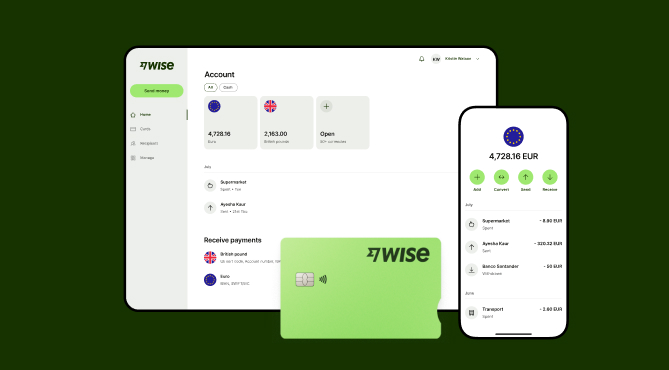
Wise Business serves as a cost-effective solution where you can receive money from around the world at the speed and price of local payments.
Transform the way you receive payments with Wise Business:
Sign up for the Wise Business account! 🚀
This general advice does not take into account your objectives, financial circumstances or needs and you should consider if it is appropriate for you.
What is a merchant account?
A merchant account is a type of business account used for accepting card payments.
Do I need a merchant account?
If your business accepts direct card payments from customers, you will need a merchant account or an alternative service.
How can I save on accepting international card payments?
Wise Business can help your business save on cross-currency transactions with low pricing and access to the mid-market exchange rate.
Sources
*Please see terms of use and product availability for your region or visit Wise fees and pricing for the most up to date pricing and fee information.
This publication is provided for general information purposes and does not constitute legal, tax or other professional advice from Wise Payments Limited or its subsidiaries and its affiliates, and it is not intended as a substitute for obtaining advice from a financial advisor or any other professional.
We make no representations, warranties or guarantees, whether expressed or implied, that the content in the publication is accurate, complete or up to date.

Read here for a review on Revolut Business in Australia. Compare multi-currency features, subscription plans, out-of-hours transfer fees, and alternatives.

Compare the best payment gateways for WooCommerce in Australia, including features, fees, payment methods, and how to choose the right integration.

Learn how the Stripe payment gateway works in Australia, including features, fees, integration options, and tips for accepting online payments.

Need a fast, frictionless, and cost-effective payment solution for your online store? We cover the best payment gateways for ecommerce.

Compare OFX vs Airwallex for Australian businesses. Explore their features, multi-currency accounts, expense management, integrations, and fees.

Learn how to set up online payments for a small business in Australia, including payment methods, providers, costs, setup steps, and common challenges.