eWay vs Stripe: Comparison for Aussie businesses
Compare eWay vs Stripe for Australian businesses. Explore all the features and fees, and how they compare with alternative solutions.



If you’re running a business in Australia and need a way to accept payments, two popular options are Adyen and Stripe. Both are global platforms boasting strong reputations, but they’re built slightly differently, with Adyen big on large-scale payment infrastructure and Stripe more focused on flexibility and integrations.
This guide breaks down Adyen vs Stripe in practical terms, taking a deep dive into features, fees, and how they compare, to help you find a payment gateway that fits your needs.
There’s also an intro to Wise Business – a multi-currency account to support and manage all your international transfers and business finances.
| Table of Contents |
|---|


Adyen is a global financial tech platform founded in 2006 in Amsterdam that now processes €970+ billion in payments annually¹. It’s built to give businesses in Australia full control over how money ‘moves’ – grouping its products into three core categories: Payments, Optimisations, and Financial Products².
Rather than acting just as a payment gateway (which it does well), Adyen brings together payments, data insights, and financial tools in one place, so businesses can process transactions and also target new revenue streams.
Stripe is a global payments and financial infrastructure platform that lets businesses accept and manage payments, when operating locally in Australia and selling internationally. It also gets through a huge volume of payments – $1.9 trillion in total in 2025.
A big part of Stripe’s appeal is its API-first design. It gives businesses the freedom to customise how payments work, from checkout experiences to billing and reporting, all within a single platform. It groups its products into four main categories: Payments, Revenue, Money Management, and Platforms and Marketplace³.
Here’s a quick rundown of how the payment gateways stack up across key features.
| Feature | Adyen | Stripe |
|---|---|---|
| Global coverage | 150+ currencies | 135+ currencies |
| Payment methods | 200+ local and global methods | 100+ methods |
| Integration | Single, centralised integration | APIs + pre-built tools and checkout |
| Billing | Basic recurring payments | Advanced billing and subscriptions |
| Fraud protection | Uplift Protect | Radar |
| Pricing model | Interchange++ | Flat-rate pricing |
Now, let’s compare Stripe vs Adyen directly, starting with an important feature: payment acceptance.
Adyen supports 19+ payment methods in Australia and hundreds globally, allowing you to tailor checkout experiences for local markets, all with one integration to keep things simple⁴. It offers five different payment categories, including direct debit, buy now pay later, gift cards, and e-wallets⁴.
One big fillip for Adyen is its access to local payment networks, with everything optimised to increase international authorisation rates⁴. That can be very valuable for larger, global businesses, where small improvements in payment success rates can translate to a big uptick in revenue.
Stripe also supports a wide range of payment methods (125+), covering cards, bank debits, real-time payments, and buy-now-pay-later options⁵. Where it really shines is how easy it is to switch these on – you can enable new methods directly from the dashboard, and Stripe will present the most relevant ones to customers using its own optimisation tools.
Its global reach is vast, too, with 135+ currencies and the ability to sell to customers in 195+ markets⁶. With Stripe, you can present prices in local currencies and manage multi-currency settlement (for a fee), which is useful for international expansion.
Adyen is designed as a single, enterprise-grade integration, where your website or app connects directly to its platform to manage payments, data, and optimization in one place². It also integrates with major systems like Oracle and Salesforce⁷. But these setups are typically more ‘hands-on’ with ongoing configuration required.
Stripe offers a large ecosystem of pre-built integrations and APIs through its own App Marketplace⁸. These are designed for a faster, ‘self-service’ setup, so you can stitch together different tools right away and start processing payments without a ton of technical expertise (you’ll still need some developer know-how).
In terms of security, both platforms are very well stocked. You’ll get PCI DSS Level 1 standards9,10 – the highest level of certification for payment security.
Stripe encrypts all financial data and layers this with access controls and its headline fraud monitoring tool, Radar, which uses machine learning trained on $1+ trillion transactions to detect suspicious activity¹¹.
Adyen offers something similar with ‘Uplift Protect’, to tackle fraud, but broadens its scope to also identify ‘good’ and ‘bad’ shoppers to improve your overall payment performance, and boost conversion and authorisation rates¹².
For recurring payments, Stripe offers multiple services in its ‘Revenue’ category, including Billing, which lets you manage all sorts of payments, including simple monthly billing to more detailed, sales-negotiated contracts, with automation to keep things running smoothly¹³. There’s also full invoicing software.
Again, Adyen’s focus is on optimisation here, instead of simply just managing subscriptions, though it does that, too. An ‘Auto Rescue’ feature uses “smart logic” to find the best time to retry failed transactions to make sure it goes through¹⁴.
Pricing is one of the big differences between Adyen and Stripe, with both using different models for transactions and fees.
Adyen uses an interchange++ model, where the fees are made up of several ‘components’ or moving parts instead of one flat rate. This includes an interchange fee for either the payment method or card network, plus a markup. These vary depending on the region.
In Australia, you’ll typically pay¹⁵:
For alternative payment methods, things work slightly differently. Instead of the interchange fee, you’ll pay a fixed percentage per transaction. For example, 3.75% for JCB and 3+% for Afterpay or Zip.
Stripe uses a simpler flat-rate pricing model, with a fixed percentage plus a small fee per transaction, which makes it easier to fully understand the costs involved¹⁶.
There are no account setup fees for either Adyen or Stripe, but you’ll have to pay for any additional features on a per-transaction or monthly basis.
Adyen says other products are “priced separately” to its payment methods, and provides a prompt to get in touch with its sales team to “calculate your pricing”¹⁵.
Stripe’s fees are more transparent – there’s a full list for all services across all categories on its pricing page. For Billing, for example, you can either pay 0.7% of the billing volume on a pay-as-you-go basis or opt for a pay monthly contract starting from $930 AUD¹⁶.
Stripe supports full and partial refunds, but it doesn’t return the original processing fee¹⁷. For chargebacks, it will cost you⁶:
Adyen also offers full and partial refunds¹⁸, but doesn’t return processing fees (which is an industry norm). Chargeback costs aren’t explicitly stated.
Adyen’s fee structure means international transactions are priced similarly to domestic payments (depending on the method). It does add a pretty hefty 3% markup on currency conversions, though¹⁹.
Stripe charges 3.5% + $0.30 AUD for international cards, with an additional 2% when converting currencies, and +1% (of volume) if you want to settle and pay out funds in different currencies¹⁶.
Taking everything we’ve covered so far into account, here’s a final review of some of the upsides and potential challenges of using either Adyen or Stripe.
| Adyen | Stripe | |
|---|---|---|
| Pros | Wide range of global payment methods and currencies | Easier to set up and use |
| Optimised payment performance tools | Transparent flat pricing | |
| Built-in financial products | Great for subscriptions | |
| Enterprise-grade integration | Very flexible integrations | |
| Cons | Complex setup process | Less control over payment routing |
| Better suited to large businesses | Add-ons increase cost | |
| Pricing harder to predict | Can get expensive at scale | |
| High FX markup | Higher fees for international cards |
A payment gateway should fit neatly into your daily workflows and how your business actually operates, while offering a balance of compelling features and value. Take some time to consider:
By using a payment gateway, you’ll be able to accept money, but the bit that comes after is important, too. Wise Business is a multi-currency account that sits alongside platforms like Adyen and Stripe to handle all your international transactions.
Expanding a business globally opens up exciting opportunities, but also new challenges like receiving payments across borders. Hidden foreign transaction fees and hefty currency conversions involved with international payments can eat into your profits and time.
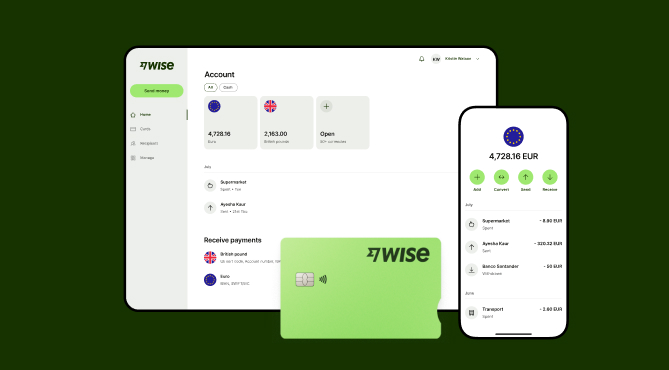
Wise Business serves as a cost-effective solution where you can receive money from around the world at the speed and price of local payments.
Transform the way you receive payments with Wise Business:
Sign up for the Wise Business account! 🚀
This general advice does not take into account your objectives, financial circumstances or needs and you should consider if it is appropriate for you.
Sources:
*Please see terms of use and product availability for your region or visit Wise fees and pricing for the most up to date pricing and fee information.
This publication is provided for general information purposes and does not constitute legal, tax or other professional advice from Wise Payments Limited or its subsidiaries and its affiliates, and it is not intended as a substitute for obtaining advice from a financial advisor or any other professional.
We make no representations, warranties or guarantees, whether expressed or implied, that the content in the publication is accurate, complete or up to date.

Compare eWay vs Stripe for Australian businesses. Explore all the features and fees, and how they compare with alternative solutions.

Compare multi-currency business accounts in Australia. Learn how they work, the fees to expect, and the best options.

Learn what third-party payments are, how they work, and their benefits. This guide covers the main types, challenges, and how to set them up for your business.

Keen to incorporate cashless payments into your small Australian business? From benefits to costs and challenges, we’re covering everything you need to know.

Learn what ACH payments are, how ACH transfers work, fees, timelines, and ways Australian businesses can send and receive ACH payments with ease.

Learn what a recurring payment is, how it works, types, benefits, and how to set up recurring payments with Wise Business in Australia.