International B2B payments: A practical guide for Australian businesses
Learn how international B2B payments work, explore common methods, understand foreign exchange fees, and discover best practices to lower cross-border costs.



When accepting payments online, most businesses don’t handle payments directly with banks. Instead, they rely on third-party payment providers to handle different parts of the transaction, from capturing payment details to settling funds.
In this blog, we’ll explain what a third-party payment is in detail, look at the different types available, and cover how Australian businesses can set them up to process both domestic and international transactions.
| Table of Contents |
|---|


A third-party payment is any transaction where an intermediary, such as a processor or gateway, handles the movement of money between a customer and a business.
Instead of the business dealing directly with a bank using a merchant account to accept payments, which can be complex and expensive, a third party steps in to manage the process instead. This includes things like collecting the customer’s payment details securely and making sure the funds are authorised and settled into the business’s account.
These third-party payments facilitate the transfer; they don’t hold or ‘own’ the money at any point, instead making sure it moves securely in line with regulations.
In practice, they typically sit between:
Third-party payments cover a few different tools or tech that handle a specific part of the transaction. These include:
Third-party payment processing covers all the mechanisms that route and secure payments after a customer has completed a checkout. It’s a chain of events that happens mostly in the background, with the end goal of making sure a transaction actually goes through securely. Here’s what it typically looks like:
The third-party payment begins when a customer enters their payment details at an online checkout to complete a purchase. After filling out the form — name, card number, CVC, etc. — they click pay to officially kick-start the whole ‘chain’ of processing, which can only take a few seconds end-to-end.
The third-party payment gateway is first up, securing the information and sending it safely to the payment processor. The encryption here prevents any sensitive information from being intercepted and exposed as it moves through different systems.
Next, the payment processor takes over and passes the transaction through the relevant card network (like Visa or Mastercard) en route to the customer’s bank. There might be a bit of back-and-forth here behind the scenes, but it happens almost instantly.
The bank then checks if there are enough funds available to complete the transaction, and flags any potential fraud if something looks unusual. Based on this analysis, it then either approves or rejects the payment. Again, this usually takes place within a second or two.
That decision travels back through the same chain, and the customer gets a ‘success’ or ‘failed’ transaction message straight away. If everything has gone as planned, the payment is authorised and ready for the next stage.
The final step is settlement. This is where approved payments are processed and transferred from the customer’s bank to the business’s bank account, which takes a bit longer, usually 1-3 days. The exact times vary depending on the bank and the transaction type (domestic or international).
Third-party payments offer a simpler alternative to traditional merchant accounts. Here are a few of the main benefits.
To use a third-party payment processor or service, you’ll usually need to integrate it directly into your website using plug-ins or APIs. Here’s a step-by-step guide with practical steps for setting up third-party payment solutions for business transactions.
Start by researching a few providers. Stripe, Square and PayPal are among the popular providers in Australia for taking cards and other payments online and in-store. Look out for:
After you’ve chosen a provider, you’ll need to connect it to your website or sales platform. Most third-party payment processors offer a few ways to do this:
The setup should be fairly quick for most businesses, especially if you’re using a standard e-commerce platform.
Next, decide how you want to receive your funds after it’s been processed. This involves:
If you’re selling internationally, this is where you might want to start thinking about lowering the cost of currency conversions and handling global finances with a multi-currency account.
The final step is to run a few test transactions to make sure payments are being processed correctly. Most providers offer a ‘sandbox’ or test environment where you can simulate various scenarios, including successful payments and refund processes, without using actual funds.
Third-party payments are convenient, but they do come with a few trade-offs or challenges that you should be aware of.
While third-party payment processors make it easier to accept credit cards or digital wallets from customers worldwide, handling cross-border payouts can quickly become expensive due to forced currency conversions and hidden markups.
Expanding a business globally opens up exciting opportunities, but also new challenges like receiving payments across borders. Hidden foreign transaction fees and hefty currency conversions involved with international payments can eat into your profits and time.
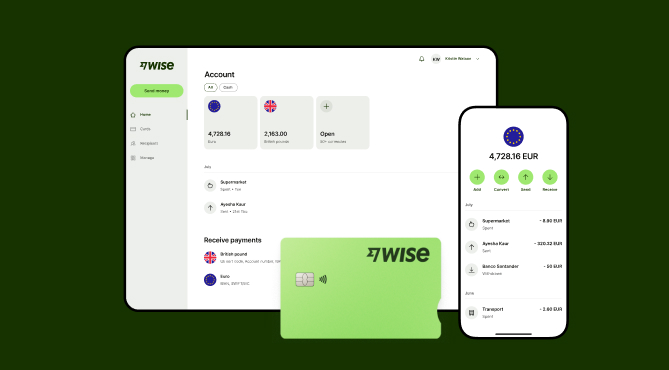
Wise Business serves as a cost-effective solution where you can receive money from around the world at the speed and price of local payments.
Transform the way you receive payments with Wise Business:
Sign up for the Wise Business account! 🚀
This general advice does not take into account your objectives, financial circumstances or needs and you should consider if it is appropriate for you.
1. What is the difference between a third-party payment processor and a merchant account?
Third-party payment processors let businesses accept payments without setting up their own merchant account. Instead, transactions are handled through a shared system, making setup much quicker and simpler. Dedicated merchant accounts are set up directly with banks, offering more control but with the caveat of stricter checks and higher fees.
2. How can I ensure the security of my third-party payments?
To secure third-party payments, choose a PCI-compliant provider that handles your sensitive data. Further safety protocols will also help, such as using tokenisation to keep card details off your servers, turning on multi-factor authentication (2FA) on your account, and keeping your website’s software and SSL certificates up to date.
3. What are the typical transfer times for international third-party payments?
A typical time frame for international-third party payments is 1-3 business days. However, it can vary depending on factors such as the provider and payment method. Some transactions can settle quite quickly (Wise completes 96% of transfers within 1 day), while others might take longer.
Sources:
*Please see terms of use and product availability for your region or visit Wise fees and pricing for the most up to date pricing and fee information.
This publication is provided for general information purposes and does not constitute legal, tax or other professional advice from Wise Payments Limited or its subsidiaries and its affiliates, and it is not intended as a substitute for obtaining advice from a financial advisor or any other professional.
We make no representations, warranties or guarantees, whether expressed or implied, that the content in the publication is accurate, complete or up to date.

Learn how international B2B payments work, explore common methods, understand foreign exchange fees, and discover best practices to lower cross-border costs.

Learn how small business payment processing works in Australia, including costs, setup steps, and how to manage domestic and international payments efficiently.

Keen to incorporate cashless payments into your small Australian business? From benefits to costs and challenges, we’re covering everything you need to know.

Learn what ACH payments are, how ACH transfers work, fees, timelines, and ways Australian businesses can send and receive ACH payments with ease.

Learn what a recurring payment is, how it works, types, benefits, and how to set up recurring payments with Wise Business in Australia.

2025 OpenAI pricing overview for API usage in Australia — token rates, tools, and smart ways to reduce next month’s bill.