International B2B payments: A practical guide for Australian businesses
Learn how international B2B payments work, explore common methods, understand foreign exchange fees, and discover best practices to lower cross-border costs.



Cash used to be king. But in today’s Tap-and-Go economy, few Australians pay with notes or coins. According to the Reserve Bank, the share of cash payments made in Australia fell from 70% in 2007 to just 13% in 2022.1
Given current consumer demand, Aussie businesses, large and small, must accept cashless payments to succeed. We’re covering all the need-to-know info, including types, benefits, drawbacks, and costs.
We’ll also introduce Wise Business, a cost-saving tool for Australians accepting payments from overseas.
| Table of Contents |
|---|


A cashless payment is any digital transaction that doesn’t involve exchanging physical cash or cheques. Cashless primarily refers to in-person payments at a Point of Sale (POS) terminal, where customers would have previously paid in cash. All online payments are cashless by definition.
A contactless payment, also known as Tap-and-Go, is when the customer does not come into physical contact with staff or a POS terminal. Instead of inserting or swiping a card and then entering a PIN, the customer taps a card – or an NFC-enabled device – within 4cm of a POS card reader.
The terminal uses Near Field Communication (NFC) to debit the correct amount, and the transaction finalises within a few seconds. Most POS systems require a PIN for contactless purchases above a certain amount, typically $100 or $200.
Australians overwhelmingly prefer contactless payments, which comprise around 95% of in-person transactions.1 Contactless payments through smartphones and wearable tech are becoming increasingly popular.
As such, virtually all modern POS systems sold in Australia now support contactless Tap-and-Go payments. “PayWave” refers to Visa contactless payments, while Mastercard uses “PayPass.”
In Australia, cashless payments appear in many forms.
While cash still plays an important role in our economy, Australians are increasingly favouring cashless payments due to their many benefits.
Convenience
Cashless payments have become popular for their convenience. Consumers no longer have to hunt down ATMs, stockpile and submit physical cash, or carry a heavy stack of coins in their wallets. As no counting change is required, businesses can process transactions in seconds, reducing customer queuing time.
Efficiency
Cashless transactions make routine bookkeeping more efficient. Businesses no longer have to count end-of-day takings and reconcile individual payments. Software can automate these accounting chores to reduce the administrative burden and lower operating costs.
Accuracy
Cashless transactions aren’t just more efficient; they’re also more accurate. Software doesn’t typically make miscalculations, meaning cleaner day-to-day bookkeeping and fewer headaches come tax time. Digital transactions let the business automatically add items such as card surcharges and GST.
Security
While businesses may need to deal with the occasional chargeback, cashless payments are generally more secure. Businesses no longer need to store much cash on premises, worry about internal or external theft, or send staff outside to deposit big stacks of cash. Although not impenetrable, cashless payments use high-level security and fraud protection to keep the risks low.
In Australia, most businesses can choose whether to go cashless. Some exceptions exist, such as grocers and fuel retailers, who must accept cash under certain conditions.2
Ready to go cash-free? Here’s how a small Australian business can start accepting cashless payments exclusively.
Evaluate the top small business payment options and POS systems for your needs, factoring in costs, logistics, and customer preferences. While a sole-trading sparkie might only need a smartphone app to accept card payments, a busy retailer may require a sophisticated cloud-based countertop POS system.
Now it’s time to shop around for payment systems. Big players like Square, Zeller, and Lightspeed handle complex security and compliance requirements – for a fee. Compare upfront costs, such as a POS system, with ongoing or per-transaction fees. Ensure the system integrates with your accounting software. Online/in-person businesses may want a service that also accepts online payments.
Study the online tutorials for your chosen payment system to learn the ropes, then train staff how to efficiently operate the POS device. Some businesses periodically monitor performance and costs to determine whether their payment system meets their needs.
The Australian Competition & Consumer Commission requires businesses to be upfront about the types of payment they accept and the minimum total price.2 Many Australian businesses post signs reading “card only” or “no cash.”
Cashless payment fees appear small on their own, often only a few cents. However, they can add up to take a sizeable chunk out of a small business's bottom line.
Some systems charge a monthly fee to rent a POS terminal or use their platform, while others charge per transaction. Small businesses should compare all fees to find the true cost of the service.
Fees vary between providers. Small Australian businesses can expect to pay the following:
In addition, many payment systems add a flat-rate per-transaction fee, often 0.25c or 0.30c.
Australian businesses could previously pass these fees on to consumers by adding a card surcharge to the POS system. But that is set to change. From October 01, 2026, the Reserve Bank will ban card surcharges, forcing businesses to charge the advertised price at checkout.3
The new regulations also aim to help small businesses by reducing the cap on interchange fees for domestic and international cards, and obliging card schemes to make their pricing structures more transparent.3
In the meantime, if you do add a card surcharge, Australian consumer law requires that it must not exceed the actual payment processing cost.4
While cashless payments offer a plethora of benefits, they also have downsides to consider.
As Australia embraces a digital-first economy, local companies face the ongoing challenge of managing transaction fees, especially when dealing with global customers. Accepting international cashless payments often comes with steep currency conversion markups that slice into profit margins.
Expanding a business globally opens up exciting opportunities, but also new challenges like receiving payments across borders. Hidden foreign transaction fees and hefty currency conversions involved with international payments can eat into your profits and time.
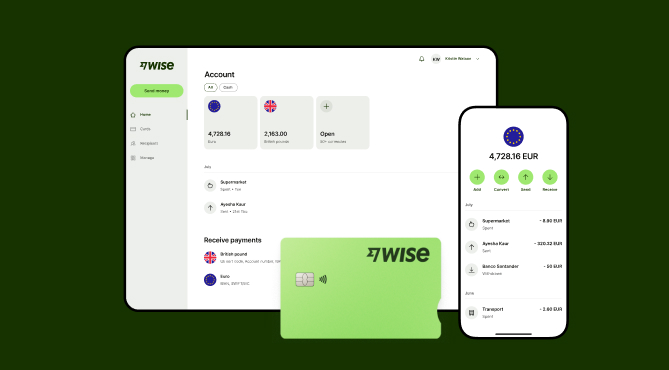
Wise Business serves as a cost-effective solution where you can receive money from around the world at the speed and price of local payments.
Transform the way you receive payments with Wise Business:
Sign up for the Wise Business account! 🚀
This general advice does not take into account your objectives, financial circumstances or needs and you should consider if it is appropriate for you.
Sources:
*Please see terms of use and product availability for your region or visit Wise fees and pricing for the most up to date pricing and fee information.
This publication is provided for general information purposes and does not constitute legal, tax or other professional advice from Wise Payments Limited or its subsidiaries and its affiliates, and it is not intended as a substitute for obtaining advice from a financial advisor or any other professional.
We make no representations, warranties or guarantees, whether expressed or implied, that the content in the publication is accurate, complete or up to date.

Learn how international B2B payments work, explore common methods, understand foreign exchange fees, and discover best practices to lower cross-border costs.

Learn how small business payment processing works in Australia, including costs, setup steps, and how to manage domestic and international payments efficiently.

Learn what third-party payments are, how they work, and their benefits. This guide covers the main types, challenges, and how to set them up for your business.

Learn what ACH payments are, how ACH transfers work, fees, timelines, and ways Australian businesses can send and receive ACH payments with ease.

Learn what a recurring payment is, how it works, types, benefits, and how to set up recurring payments with Wise Business in Australia.

2025 OpenAI pricing overview for API usage in Australia — token rates, tools, and smart ways to reduce next month’s bill.