Revolut business review: Plans, fees, and Australian alternatives
Read here for a review on Revolut Business in Australia. Compare multi-currency features, subscription plans, out-of-hours transfer fees, and alternatives.



If you’re looking to create a store or website and sell to customers online, you’ll need an ecommerce platform. There are quite a few options for Australian businesses, including all-in-one website builders that combine features to make it easier to manage everything in one place.
This guide will compare five of the best e-commerce platforms in Australia, covering key features and pricing, and an overview of what each provider is best suited for. There’s also an intro to Wise Business – a multi-currency account you can use to manage all your global ecommerce payments.
| Table of Contents |
|---|


An ecommerce platform is software that allows businesses to build and run an online store to sell goods and services, with tools to optimise checkouts and take payments, as well as manage other retail tasks like sorting inventory and shipping. Most ecommerce platforms bring together all these features, so businesses can handle most of their operations through a single platform.
They generally help Australian businesses to:
As we’ve noted, most modern e-commerce platforms now function as full business management systems, rather than merely digital storefronts. They have tools covering pretty much everything from website building to marketing and customer engagement.
When comparing e-commerce platforms, you’ll typically want to shortlist those with:
There’s no shortage of feature-rich ecommerce platforms in Australia. These five platforms cater to most small business needs, from launching a first online store to leveling up to something bigger and more capable as you grow.
Here’s an overview of the platforms by price for the recommended plan and potential target market.
| Platform | Pricing (AUD) | Best for |
|---|---|---|
| Shopify² | From $149 per month | Growing businesses that sell online |
| WooCommerce¹⁰ | Free platform; hosting at $25–$350/mo, and any extensions at $29–$299/yr each. | WordPress users |
| Wix²¹ | From $55 per month | Beginners and small stores |
| Squarespace²⁵ | From $28 per month | Creatives and service businesses |
| BigCommerce²⁸ | From $79 per month | Scaling online retailers |
Now, we’ll compare each one in more detail, starting with Shopify.
Shopify is one of the biggest global ecommerce platforms – it says its merchants have collectively made $1.1 trillion in sales². As an all-in-one hosted platform, it’s got pretty much everything an Australian business needs to start selling and then scale afterward, thanks to its huge number of commerce app integrations (21,000+) and international selling features¹.
Shopify groups its services into five core categories: Build Your Website, Run Your Business, Sell Anywhere, Get Paid, and Marketing & Analytics. Within each of these are key features, including:
Shopify pricing
Shopify has four subscription plans: Basic, Grow, Advanced, and Plus, starting at a promotional $56 AUD per month (or $42 AUD when billed annually), and going up to $3,700 AUD per month for the top tier. You’ll also have to pay a per-transaction fee to accept most payments, including cards (standard rate of 1.75% + $0.30).
WooCommerce is an open-source plugin built for WordPress websites. It powers around a third of the top ecommerce sites globally, and is known for its flexibility – businesses have more control over their website and costs compared to ‘fully hosted’ platforms. The slight caveat is that it requires a bit more hands-on management and technical expertise to set up and manage.
WooCommerce has four main categories on its website: Sell, Extensions, Resources, and Enterprise ecommerce. Because it’s open source, there are lots of tools and guides aimed at developers to help them build powerful, fully customised stores.
With this platform, you can:
WooCommerce pricing
WooCommerce uses a ‘flexible and transparent’ pricing model¹⁰. You don’t have to pay for the plugin itself, but there are card payment processing fees of 2.50–2.90% + $0.30 AUD per transaction. You’ll also typically pay separately for hosting, themes, and plugins that you use with WordPress and WooCommerce.
Wix is a beginner-friendly website builder designed to help businesses create online stores quickly without technical experience. It combines ecommerce, bookings, marketing, and customer management tools into a single platform – ideal for small businesses and service- based brands that want an easy ‘all-in-one’ solution¹⁶.
Wix also offers a strong set of booking tools, including purpose-built features for restaurants to manage menus and reservations, as well as tools for appointments and events. This makes it stand out from competitors that focus more narrowly on product-based selling.
With Wix, you can:
Wix pricing
Wix has five main plans: Free, Light, Core, Business, and Business Elite²¹. The Business plan is ‘recommended’ by Wix as the starter with its fleshed-out feature set, with a full suite of payment and marketing tools, plus higher allowances. This costs 55 AUD per month. Business Elite is priced at 199 AUD per month.
Squarespace is a website builder that prioritises aesthetics, offering clean, minimalist designs that can be refined using AI tools. While it’s often closely associated with portfolios and websites for creative professionals, its feature set is quite broad, extending to invoicing, scheduling, SEO, and domain transfers, making it ideal for most businesses selling products or services online²².
Squarespace groups its products into four main categories: Website, Business, Marketing, and Business Tools. There’s also a Resources sub-menu with a Help Centre, Forum, and a series of Webinars to help you along the way²².
With Squarespace, you can²³:
Squarespace pricing
Like most other platforms, Squarespace has four subscription plans, starting with Basic for $17 AUD per month and topping out with Advanced at 109 AUD per month (when paid annually)²⁴. The ‘Core’ package (28 AUD per month) might be the best to start with, as it has all the core website-building features, plus useful business tools like advanced analytics.
To accept credit cards, you’ll also have to pay a per-transaction fee, from 1.35% + $0.30 AUD, depending on the plan.
BigCommerce, as the name suggests, is a platform aimed at growing online retailers and stores with larger product catalogues. It states that it’s “built for momentum” with tools that make it easier to scale across channels and different regions – all from a single platform²⁵. One other notable benefit is the absence of additional transaction fees across all sites and plans.
The main features are grouped by platform and service, covering everything from small business tools to bigger B2B industry capabilities.
With BigCommerce, you can²⁷:
BigCommerce pricing
BigCommerce has four main plans: Core, Growth, Scale, and Performance. The entry-level Core plan targeted for new businesses is priced at 29 AUD per month when billed annually, while Growth for “established businesses scaling toward 100k annual sales” rises to 79 AUD per month. The processing fee for debit and credit cards begins at 2.89% + $0.29 per transaction for all plans²⁸.
For Australian businesses selling internationally, ecommerce platforms can help you accept sales from local customers overseas, but managing those cross-border payments afterward can quickly become complex and expensive due to currency conversion fees and markups.
Expanding a business globally opens up exciting opportunities, but also new challenges like receiving payments across borders. Hidden foreign transaction fees and hefty currency conversions involved with international payments can eat into your profits and time.
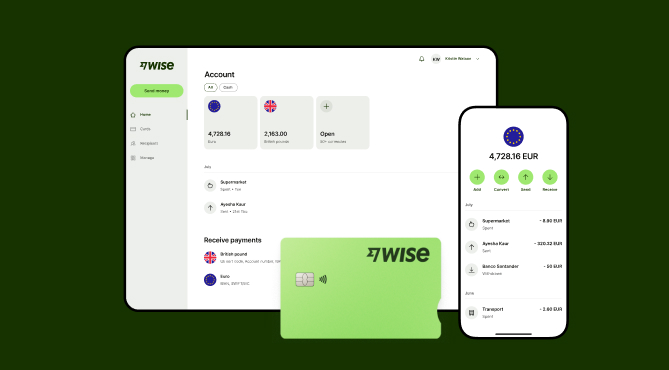
Wise Business serves as a cost-effective solution where you can receive money from around the world at the speed and price of local payments.
Transform the way you receive payments with Wise Business:
Sign up for the Wise Business account! 🚀
This general advice does not take into account your objectives, financial circumstances or needs and you should consider if it is appropriate for you.
1. How much does it cost to set up an ecommerce store in Australia?
Costs can vary quite a bit depending on the platform you choose and how you plan to market your store. As a rough guide, most new businesses spend somewhere between 30 to 100 AUD a month on ecommerce software, with extra costs for things like a domain name, plugins, and the transaction fees that come with taking online payments.
2. Can I sell on multiple ecommerce platforms at the same time?
Yes – most modern platforms make multi-channel selling pretty straightforward. You can usually list products on your own store, social media, and marketplaces like eBay or Amazon at the same time, which helps you reach more customers without the burden of managing each one individually.
Sources:
*Please see terms of use and product availability for your region or visit Wise fees and pricing for the most up to date pricing and fee information.
This publication is provided for general information purposes and does not constitute legal, tax or other professional advice from Wise Payments Limited or its subsidiaries and its affiliates, and it is not intended as a substitute for obtaining advice from a financial advisor or any other professional.
We make no representations, warranties or guarantees, whether expressed or implied, that the content in the publication is accurate, complete or up to date.

Read here for a review on Revolut Business in Australia. Compare multi-currency features, subscription plans, out-of-hours transfer fees, and alternatives.

Compare the best payment gateways for WooCommerce in Australia, including features, fees, payment methods, and how to choose the right integration.

Learn how the Stripe payment gateway works in Australia, including features, fees, integration options, and tips for accepting online payments.

Need a fast, frictionless, and cost-effective payment solution for your online store? We cover the best payment gateways for ecommerce.

Compare OFX vs Airwallex for Australian businesses. Explore their features, multi-currency accounts, expense management, integrations, and fees.

Learn how to set up online payments for a small business in Australia, including payment methods, providers, costs, setup steps, and common challenges.