Which is the Best Trading Platform in Singapore? A Beginner's Guide
Looking to start trading? Check out our guide which compares top platforms like Moomoo, Tiger Brokers, and more to help you start investing



As investment platforms go digital and become more accessible, there’s growing interest in international investments like the US S&P 500 as a way to diversify and build a balanced portfolio.
The S&P 500 includes 500 of the largest and most successful companies from the US, across a broad segment of sectors like IT, finance, consumer, and communications. You can get involved by choosing either an S&P 500 ETF in Singapore or an S&P 500 index fund available in Singapore.
This guide covers how to invest in the S&P 500 from Singapore, including choosing a platform and the costs to consider before you trade. We'll also introduce the Wise account, a handy companion to make your money go further with low, transparent fees.
| Table of contents |
|---|
Before we look at how to buy S&P 500 assets in Singapore, let’s look at a more basic question: what is the S&P 500?
The S&P 500 was formerly called the Standard & Poor’s 500 and is an index of the shares of 500 of the largest and most important companies on the US market¹.
Indices like the S&P (and others you may have heard of, like the Dow Jones) are used to benchmark the health of an economy by tracking the performance of key businesses.
You can’t actually buy into an index like the S&P, but you can buy into exchange-traded funds (ETFs) and index funds that track the performance of the index. This is a commonly used tactic to create a balanced exposure to important stocks and shares in a given market.
This guide is for information only, and does not constitute advice. The value of investments can go down as well as up - get professional advice before you put your money at risk.
Here are some of the most important companies included in the S&P index, to give you an idea of the types of business you’ll find featured there.
| Company² | Symbol | Industry |
|---|---|---|
| NVIDIA | NVDA | IT |
| Microsoft | MSFT | IT |
| Apple | AAPL | IT |
| Amazon | AMZN | Consumer |
| Meta | META | Communications |
| Broadcom | AVGO | IT |
| Alphabet (CLASS A) | GOOGL | Communications |
| Alphabet (CLASS C) | GOOG | Communications |
| Berkshire Hathaway | BRK.B | Finance |
| Tesla | TSLA | Consumer |
*Details correct at time of research - 3rd September 2025
The S&P 500 can be a good place to invest as the performance of this index tracks the performance of the largest businesses in the US, across all sectors. This can help you to reduce your exposure to individual companies and spread your investments across a broad base.
While investment funds can go down as well as up, tracking an index can be a way of lowering the risks involved in investing, making this a popular tactic for both new investors and seasoned investors alike.
Yes. You can buy both index funds and EFTs in Singapore that follow the performance of the S&P 500.
You can buy into one S&P ETF, which is traded on the Singapore stock exchange, or you can choose from a broad range of options if you use a broker that has access to the US market. Both of these solutions are available for Singapore investors, and which works best for you may depend on the broker you prefer to use.
Wondering which S&P 500 ETF to buy in Singapore? Here are some of the most popular S&P 500 funds available in Singapore.
| ETF name | Symbol | Listed in |
|---|---|---|
| SPDR S&P 500 ETF Trust³ | S27 | SGX |
| Vanguard S&P 500 ETF⁴ | VOO | NYSE |
| iShares Core S&P 500 ETF⁵ | IVV | NYSE |
| SPDR S&P 500 ETF Trust⁶ | SPY | NYSE |
*Details correct at time of research - 3rd September 2025
Investing is pretty accessible with a broad range of broker types and options, and ways to start your investment journey with fairly small amounts of money. However, as investments may fall in value, it’s really important that you understand the risks that can apply before you put any of your hard-earned cash on the line.
Do your own research before you start to invest, and get professional advice if you need to.
Once you’re comfortable with the process, pros, and cons, you’re ready to invest in the S&P 500 from Singapore. Here’s how to buy index funds in Singapore:
- Select an investment platform, including local banks and local or international digital providers.
- Create a brokerage account - you’ll need to get verified before you can start to trade.
- Fund your brokerage account in SGD or USD, depending on the provider.
- Follow the provider’s process to buy into your preferred ETF or index - check the fees that apply before you confirm.
- Track your investment progress using the provider's digital tools - usually an app.
There are several different types of investment platforms available to an investor in Singapore, and each has its own advantages and disadvantages. We’ll cover what to look at as you choose your preferred platform in a moment - first, here are the most common platform types you’ll come across while you research:
More traditional brokerage firms can be standalone businesses, but are commonly under the investment division of a major bank. Using a local firm may mean you get more tailored advice for the market, including support for CPF investing. You might also be able to get face-to-face help - but you’re likely to find fees are relatively high compared to some other options.
Many major brokers operate globally, with offices around the world and easy access to different markets. This allows them to keep up to date with the performance of different exchanges, to offer advice to investors who are interested in diversification across different geographies. There are many different options out there, so you’ll need to compare costs and service options carefully to decide which might fit.
Robo-advisors are generally platforms that can help you invest using algorithms and digital analysis tools to decide which assets and strategies might work. There are robo-advisors in the Singapore market which are digital only, and some which are offered through banks and other more traditional providers. Costs are often low, but you won’t usually get face-to-face or phone consultations with a provider like this.
Let’s work through a few pointers on other things to think about before you invest. Remember to get professional advice if you’re ever unsure about how to manage your assets and your money, to avoid unnecessary risk.
Using a platform with low ongoing costs, which doesn’t charge too much for individual trades or transactions, can help you make the most of your money. The range of fees and costs involved can depend a lot on the type of provider you use and the exact assets you buy. You may need to pay a commission every time you trade, for example, and you might also run into account management fees or foreign exchange fees when you convert to and from USD.
Foreign exchange costs can end up eating into your profits if the platform you use adds a large markup to the exchange rate used when you sell your USD assets and convert the funds back to SGD to withdraw to your bank. If you’d prefer, you might find you can save money by withdrawing in USD to an account from a provider like Wise, which allows you to hold USD and convert when you’re ready with the mid-market exchange rate.
You’ll need to weigh up the full range of costs applied by any provider you might consider. Here are a few popular ones, alongside key cost considerations for buying US assets.
| Platform | Commission fees | Platform fees |
|---|---|---|
| IBKR⁸ | Tiered or flat pricing, from 0 USD/share | No added platform fee |
| DBS Vickers⁷ | From 0.15% | None specified |
| Moomoo⁹ | No commission | 0.99 USD/ order |
| Tiger Brokers¹⁰ | Prime accounts from 0.005 USD/share | Prime accounts from 0.005 USD/share |
*Details correct at time of research - 3rd September 2025
There's a 30% dividend withholding tax on US stocks owned by foreign persons, which is retained by the platform and paid to the US government¹¹. Generally, your platform will deduct this tax once a dividend is paid, and you’ll be able to see the deduction in your account details.
When you're selecting a way to invest in S&P assets from Singapore, don’t forget to look for a platform that’s easy to use. Many brokers now offer apps to help you buy, sell, and check your account transactions while you’re out and about. This can make it far easier to keep on top of your money.
Depending on your personal preference, you might also want to look for a platform that offers easy access to share data, trackers, and analysis to help guide your decisions and investments. Look for online reviews of different providers to get a sense for how easy customers find their services to understand and use, before you select the right one for you.
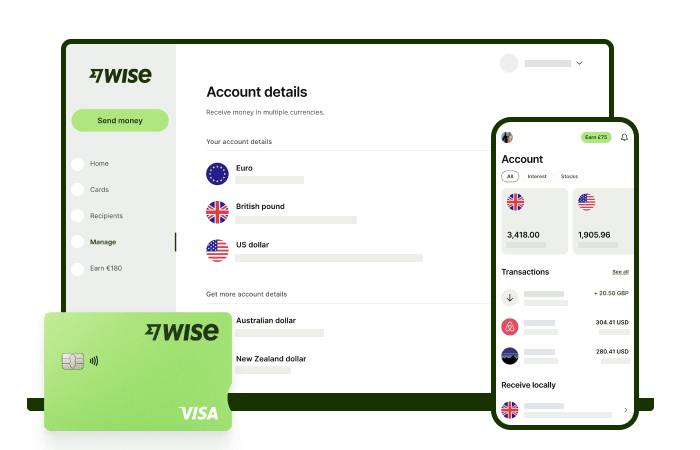
When buying or selling international stocks, hidden fees on cross-currency transfers can reduce your profits. Use Wise to minimise these costs and help maximise your returns.
The Wise account is an easy way to hold and exchange 40+ currencies, including SGD, MYR, EUR, CNY, and more. All you need to do is create a free account to get started.
With Wise, you can exchange currencies at the mid-market rate each time, with low, transparent conversion fees from 0.26% and absolutely no markups. Plus, you can order a linked Wise card for convenient spending without any foreign transaction fees, and up to 2 free ATM withdrawals to the value of 350 SGD when you're overseas. You'll even get 8+ local account details to get paid conveniently to your Wise account in SGD and a selection of other major global currencies.
What's more, you can activate Wise Interest to earn returns* on your eligible balances while keeping your money available to spend.
*Growth is not guaranteed. Capital at risk.
Sending money or making payments abroad? Wise also offers fast, low cost transfers to 140+ countries - you can track your transfer in your account and your recipient will also be notified when a transfer reaches them.
*Please see terms of use and product availability for your region or visit Wise fees and pricing for the most up to date pricing and fee information.
This publication is provided for general information purposes and does not constitute legal, tax or other professional advice from Wise Payments Limited or its subsidiaries and its affiliates, and it is not intended as a substitute for obtaining advice from a financial advisor or any other professional.
We make no representations, warranties or guarantees, whether expressed or implied, that the content in the publication is accurate, complete or up to date.

Looking to start trading? Check out our guide which compares top platforms like Moomoo, Tiger Brokers, and more to help you start investing

Considering the Maybank Family & Friends card? Read our 2025 review on its cashback, benefits, and fees. Find out if it's the right fit for your spending.

Compare the OCBC 90°N, VOYAGE and Premier Visa Infinite cards to find Singapore’s best OCBC miles credit card for your spending habits and travel goals.

Looking for the best credit card with free travel insurance in Singapore? Compare top cards like UOB and AMEX to get complimentary coverage and save on trips.

Thinking about the Revolut metal plan and card in Singapore? Our detailed review covers the benefits, features and fees to help you decide if it’s worth it.
Compare the AMEX KrisFlyer Ascend, KrisFlyer, and Platinum cards. See their miles earning rates, annual fees, and perks to pick your best AMEX travel card.