Comparing the Best Corporate Cards for NZ Businesses
Looking for the best corporate cards for your New Zealand-based business? We’re covering a few choice options in this business card comparison article.



From payroll to card processing, the typical Kiwi business sends and receives a multitude of EFT payments each week. But what does EFT mean? And how can it help New Zealand-based businesses cut costs and streamline operations?
We’re covering everything a Kiwi SMB needs to know about EFTs in this post.
| Table of Contents |
|---|


In New Zealand and around the world, the “electronic funds transfer,” or EFT, is an umbrella term for any sort of electronic payment. This all-encompassing acronym covers digital payments made between businesses, consumers, governments, or institutions – all payments other than cash or cheque.
Be careful not to confuse EFTs with ETFs (Exchange Traded Funds), which are diversified stock market investments.
EFT payments offer a broad range of business benefits.
Convenience: Most Kiwis prefer paying by electronic methods, such as bank transfers or contactless card payments, rather than antiquated cash or cheques.
Speed: In-person contactless card payments process instantly to reduce checkout queues, while online electronic payments settle faster than cash or cheque deposits.
Efficiency: Automation reduces the burden of manual administrative tasks such as payroll, reconciliation, and invoicing.
Cost-effective: Businesses save money on administration as well as printing and mailing costs.
Security: Businesses don’t have to store large wads of cash on premises, while encrypted payment systems reduce the risk of fraud.
Bookkeeping: EFT payments leave a digital record for easy reconciliations and accounting.
Traceability: Electronic transfers are traceable, making it simpler to track misrouted payments and identify fraud.
Accuracy: Many electronic payments are automated, reducing the likelihood of human error-related issues.
Due to their benefits, cashless payments for small businesses have become the norm. According to the Reserve Bank of New Zealand, debit/EFTPOS cards account for 80% of transactions made in New Zealand.1
New Zealand businesses have plenty of options for accepting or making electronic payments.
Most Kiwi businesses use a POS system with a card reader to process in-person card payments, or a payment portal for online, card-not-present transactions. While convenient, card schemes such as Visa and Mastercard charge fees. Many merchants pass these on to consumers through surcharges.
The Eftpos card scheme is free in New Zealand, but the customer must insert or swipe an Eftpos card at an EFTPOS terminal and choose “CHQ” or “SAV” to access it. Contactless and digital wallet payments aren’t compatible.2
Digital wallets, such as Google Wallet and Apple Pay, use tokenisation to securely store card details. Customers make contactless payments on their smartphones using near-field communication (NFC) technology. Digital wallets can also be used for online payments and attract similar fees to cards.
In New Zealand, bank transfers route through the Bulk Electronic Clearing System (BECS).3 Operating by Payments NZ, BECS is an account-to-account (A2A) payment system that exchanges payment information and settles transactions in multiple batches throughout the day. The payer initiates a bank transfer through a mobile app or online banking portal.
Automatic payments are recurring payments in which the payer schedules a bank transfer to automatically occur at certain intervals, such as weekly or monthly. The payer can only select fixed amounts and can cancel the scheduled transaction at any time.
With a direct debit, the customer completes an authorisation form allowing the business to withdraw funds directly from their account at agreed-upon intervals. The business then instructs the customer’s bank to schedule the recurring payment. Direct debits can be fixed or variable.
The direct deposit is the inverse of a direct debit. The recipient completes a form authorising the payer to credit funds directly into their bank account at agreed-upon intervals. Direct deposits can be fixed or variable.
Unique to New Zealand, POLi is a popular online payment system that debits funds directly from the payer’s nominated account rather than a card. POLi payments usually have lower fees than cards, and don’t require disclosing card details. The service only works for domestic NZ transactions.
Even though cash is exchanged, an ATM withdrawal technically counts as an EFT because the ATM electronically communicates with the recipient’s bank.
BNPL systems like Zip and Afterpay let consumers purchase a product or service instantly and repay it through installations over time. The customer doesn’t usually pay interest, though steep late-payment fees may apply.
While BNPL generally attracts higher fees than cards, it could help businesses acquire more customers. According to a 2024 Ministry of Business, Innovation, & Employment survey, over a third of New Zealanders made a BNPL purchase in the last two years.4
Nowadays, the typical Kiwi business sends and receives most payments electronically. Standard use cases, and their most common payment types, include:
Utility bills: Recurring payments through direct debit or POLi
Paying suppliers: Cards and bank transfers
Payroll: Direct deposit (AKA direct credit) or scheduled bank transfers, often processed through payroll or accounting software
In-person purchases: Contactless payments through EFTPOS, Visa, Mastercard, or digital wallet (Google Wallet, Apple Pay)
Online purchases: Payment gateways accepting cards and digital wallets, or POLi
Rent: Tenant-initiated recurring bank transfers
Taxes: Bank transfers or a “pay IRD” feature through an online banking app
Investments: Bank transfers or debit cards
Voluntary superannuation: Payroll deductions (salary sacrifice) for pre-tax contributions, bank transfers or BPAY for post-tax contributions.
International payments: Cards or bank transfers, though many charge hefty international transfer and foreign exchange fees
The precise process varies by payment type. Nonetheless, most EFTs follow similar steps:
Most of this occurs behind the scenes with little or no manual intervention. The payer, for example, may only need to enter a PIN or verify biometrics, while the vendor only needs to set the correct charge.
Domestic EFT payments are cost-effective in New Zealand, especially when using POLi, Eftpos, or BECS.
International transactions, on the other hand, can become quite costly. Overseas card payments and bank transfers incur significantly higher fees than domestic transactions for an equivalent amount.
But the biggest expense is baked into the exchange rate. Many banks and card schemes add a hidden markup to the foreign exchange rate, typically as high as 2-3%. Users often don’t see these fees up front and won’t know how much the recipient will receive until the transaction is finalised.
While domestic EFT payments work well for local everyday transactions, managing cross-border transfers often introduces high fees and poor exchange rates that chip away at your bottom line.
Expanding a business globally opens up exciting opportunities, but also new challenges like receiving payments across borders. Hidden foreign transaction fees and hefty currency conversions involved with international payments can eat into your profits and time.
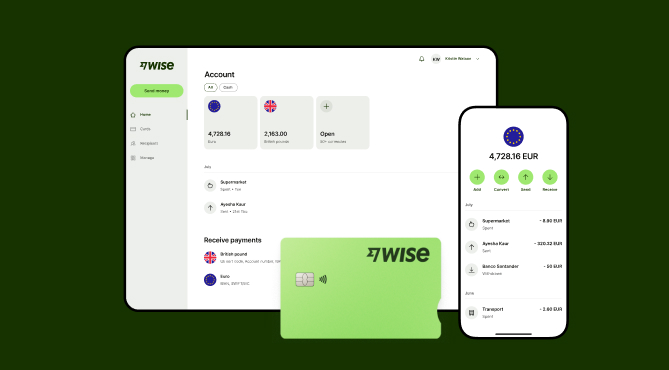
Wise Business serves as a cost-effective solution where you can receive money from around the world at the speed and price of local payments.
Transform the way you receive payments with Wise Business:
Sign up for the Wise Business account! 🚀
This is not financial or investment advice - Wise has not taken into account your objectives, financial circumstances or needs and you should consider if it is appropriate for you.
1. Is an EFT payment the same as a bank transfer?
Not exactly. A bank transfer is an EFT. But the term EFT also includes card payments, direct deposits, and other digital payments.
2. How do I initiate an EFT transfer in New Zealand?
To start an EFT in New Zealand, open your online banking app, enter the recipient details, and confirm the transaction.
3. How long does an EFT payment usually take?
Processing times vary by payment type, from a few moments (card payments) to five business days (some direct deposits).
Sources:
*Please see terms of use and product availability for your region or visit Wise fees and pricing for the most up to date pricing and fee information.
This publication is provided for general information purposes and does not constitute legal, tax or other professional advice from Wise Payments Limited or its subsidiaries and its affiliates, and it is not intended as a substitute for obtaining advice from a financial advisor or any other professional.
We make no representations, warranties or guarantees, whether expressed or implied, that the content in the publication is accurate, complete or up to date.

Looking for the best corporate cards for your New Zealand-based business? We’re covering a few choice options in this business card comparison article.

We’re covering how to accept online payments to help Kiwi entrepreneurs mitigate risks, build trust, and expand their e-commerce stores.