What are retained earnings? Guide for Australian businesses
Learn about retained earnings, the formula, balance sheet impact, and how to use accumulated profits for sustainable growth. Read here.


Taking payments over the phone from a customer remotely is a practical way to get paid for many small businesses in Australia. When done right, it’s fast and convenient. But it can increase exposure to fraud and chargebacks, and often comes with higher processing fees, so it’s worthwhile to have a full picture of the challenges involved.
In this guide, we’ll explore in-depth how to complete payments over the phone, looking at what it means, the pros and cons, different payment methods, and a step-by-step guide to getting it set up for your business.
We’ll also look at how multi-currency accounts like Wise Business can facilitate phone-based payments in different currencies at low fees.
| Table of Contents |
|---|

Taking payments over the phone is a type of card-not-present (CNP) transaction, where the cardholder isn’t physically present, and instead the payment details are shared verbally during a phone call and processed manually by the business.
In practice, the customer will provide their card details (card number, expiry date, CVV, etc.) and the business then enters them into a secure system. This makes it fundamentally different to payments via an online checkout or in-person terminal, where the customer thumbs in all the relevant info or uses a chip and pin.
These phone payments can help businesses to complete transactions quickly and reach new customers.
However, because the card isn’t physically there at the point of sale, phone payments are often treated as a higher risk by banks and card networks.
Businesses focused mainly on online card payments, might be unaware of the upsides of using what might appear to be an ‘old school’ method over the phone.
It can be very useful in certain situations, though. Here’s why:
Taking phone payments might be deemed a necessity for businesses in specific industries. For example, tour operators in Australia would likely lose out on lots of custom if they didn’t take bookings or deposits over the phone. For other industries, it might be optional but still beneficial.
Here are some other examples.
There are a few drawbacks or challenges to consider when taking phone payments. These include:

There are a couple of popular methods for accepting payments over the phone in Australia.
A virtual terminal is a web-based payment interface provided by a payment processor such as Stripe. To complete a phone payment, staff can enter the customer’s card details directly into the system using any secure computer, such as a laptop or smartphone.
A big benefit here is that no physical hardware is required, and the virtual system usually supports receipts and reporting. However, it does require strong internal security practices to safeguard sensitive customer details.
EFTPOS, an acronym for Electronic Funds Transfer at Point of Sale, is a term used interchangeably for both in-store card terminals and Australia’s card scheme and network.
Some EFTPOS providers allow manual card entry on physical terminals. Like the previous method, staff manually key in a customer’s card details instead of inserting or tapping a physical card. This is a convenient option as it uses existing EFTPOS hardware and follows a familiar workflow for staff.
To complete phone payments, you’ll need to put some basic (yet essential) building blocks in place first to support fast and secure transactions. Here’s what to prepare and how to get things up and running.
Before you start accepting phone payments, you’ll need:
An eligible payment provider - one that supports MOTO transactions or manual card entry. Popular providers include Stripe and Square.
PCI DSS compliance measures - PCI DSS is the payment card industry data security standard with a set of rules that you must follow to handle all the card data give to you by customers¹. A failure to comply can lead to costly data breaches and big fines and penalties.
Secure systems and staff training - always use trusted payment systems, and restrict access to trained staff only, while avoiding storing or recording card details after transactions are completed.
Clear internal processes - make sure to document clear protocols for when phone payments are allowed, how details are entered, and the way disputes or chargebacks are handled.
Here’s a general overview of the steps to get phone payments set up. The main logistical requirements are selecting a relevant payment provider and enabling a secure way to process payments during calls.
Now, let’s look at an alternative phone payment option using Wise Business.
Wise Business doesn’t offer an online card terminal or card machine, but it does support a bank transfer-based approach where a payment is agreed over the phone and completed securely by the customer.
This might be preferable for businesses that want to avoid handling card details altogether, which makes the process safer.
To take payments over the phone with Wise, all you need to do is:
Expanding a business globally opens up exciting opportunities, but also new challenges like receiving payments across borders. Hidden foreign transaction fees and hefty currency conversions involved with international payments can eat into your profits and time.
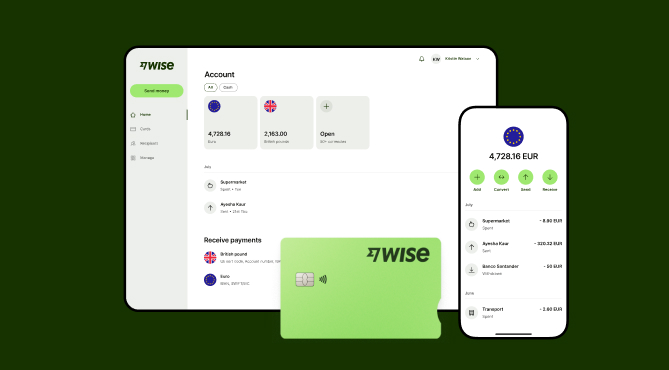
Wise Business serves as a cost-effective solution where you can receive money from around the world at the speed and price of local payments.
Transform the way you receive payments with Wise Business:
Sign up for the Wise Business account! 🚀
This general advice does not take into account your objectives, financial circumstances or needs and you should consider if it is appropriate for you.
1. Is it safe to take payments over the phone?
It can be safe to take payments over the phone when done correctly. But they are inherently more risky than in-person or online payments. That’s why it’s vital to follow strict PCI DSS compliance protocols like using secure systems and not storing card details afterwards.
2. Who bears the fees when taking phone payments?
There are processing fees when taking phone payments, and these are typically charged to the business, not the customer. As phone payments involve higher fees due to the increased risk of fraud, you might want to factor this into pricing for specific products and services.
Sources:
*Please see terms of use and product availability for your region or visit Wise fees and pricing for the most up to date pricing and fee information.
This publication is provided for general information purposes and does not constitute legal, tax or other professional advice from Wise Payments Limited or its subsidiaries and its affiliates, and it is not intended as a substitute for obtaining advice from a financial advisor or any other professional.
We make no representations, warranties or guarantees, whether expressed or implied, that the content in the publication is accurate, complete or up to date.

Learn about retained earnings, the formula, balance sheet impact, and how to use accumulated profits for sustainable growth. Read here.

Learn how to calculate GST in Australia. Understand inclusive vs exclusive pricing, claim GST credits, and avoid common pitfalls to ensure business compliance.

Demystify business turnover. Learn how to calculate gross income, understand gst thresholds, and distinguish turnover from profit for your business.

Discover what a VAT number is and how it differs from Australian GST. Learn why the ABN matters for international business and more. Read here

Understand IBAN, how they differ from BSB codes, and when you need them for international transfers. Learn to navigate global payments.

Learn how to accept online payments in Australia. Learn about methods like gateways, links, and bank transfers and managing fees, security, and compliance.